Personalization is worth it when a business has enough traffic and real data for differences between visitor segments to actually matter; it’s a distraction when it doesn’t. Knowing which side of that line you’re on decides whether the Personalize step belongs in your plan yet at all.
Personalization gets pitched as something every business should be doing. That’s not honest, and knowing the honest threshold matters more than the pitch.
Key takeaways
- Personalization needs a large enough, frequent enough segment for a difference between visitors to be signal, not noise.
- If a page still loses most visitors regardless of who they are, that’s a conversion problem to fix first, not a personalization opportunity.
- “Worth it” means a real, observable segment difference, not personalizing because a platform makes it technically possible.
- The same statistical reality that governs trustworthy A/B testing governs trustworthy personalization: signal takes volume.
- This isn’t your priority yet if your funnel still loses most visitors before any segment split matters, or if you can’t yet name a segment with real, repeatable volume behind it.
What has to be true for personalization to work?
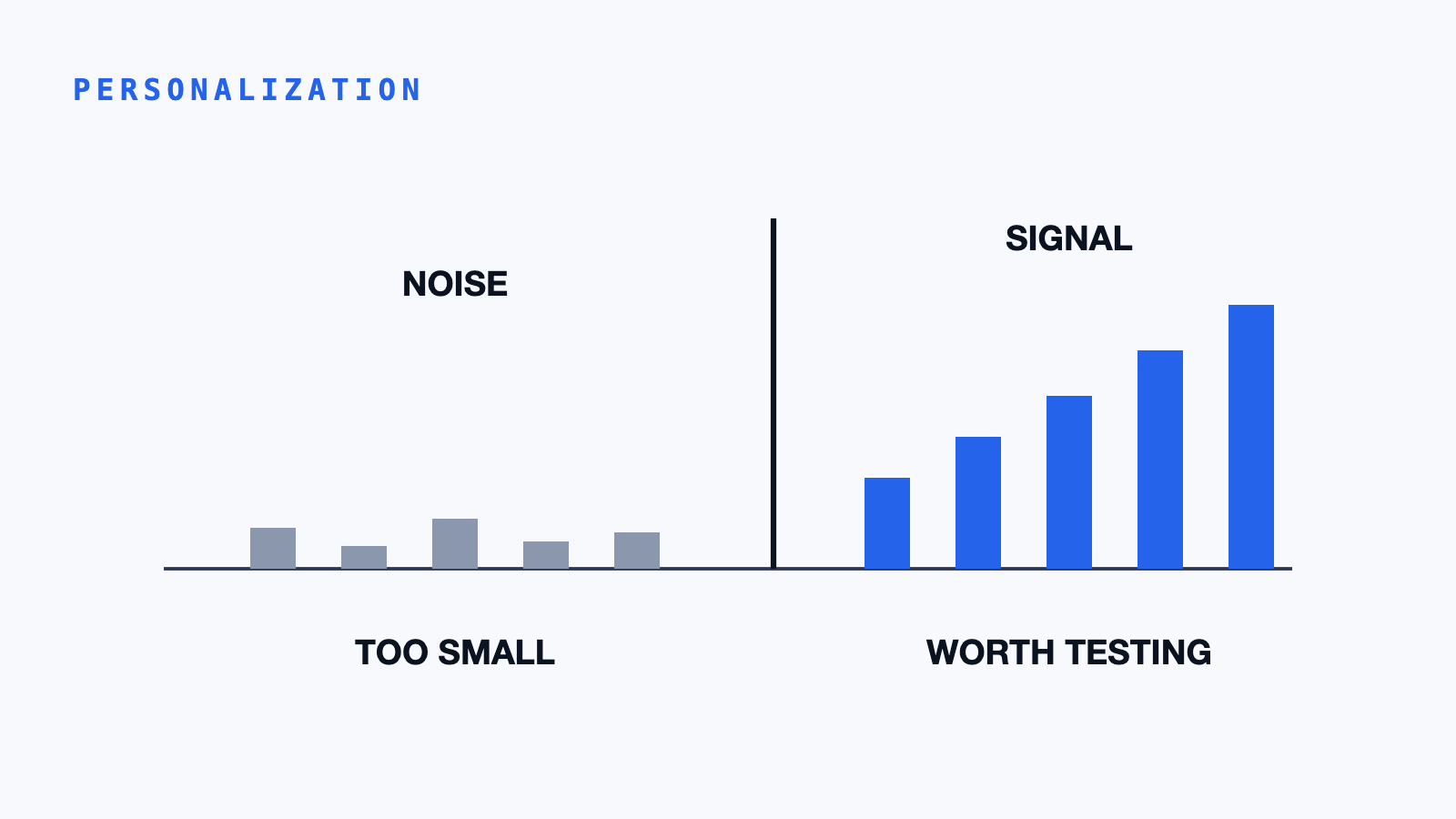
Enough visitors in each segment for a real, repeatable pattern to exist, not a guess dressed up as a segment. If “returning visitors” is a group of a handful of people a month, there’s no meaningful pattern to act on yet, and any “personalized” experience for them is really just a guess with extra steps. Personalization needs a large enough segment, seen often enough, for a difference in behavior to be something other than noise. This is the same statistical reality that governs how long it takes CRO to show results: trustworthy signal takes volume, in personalization exactly as much as in testing.
Alt text: Two line charts side by side; the small-segment line is jagged and unreliable, the large-segment line is smooth and stable, illustrating why segment size decides whether a pattern is real.
What’s the honest case for waiting?
If your traffic is still thin or your funnel still has larger, more universal problems, personalization is solving the wrong layer first. A page that loses most visitors regardless of who they are needs a conversion fix, not a personalized version of the same broken experience, see where your funnel actually leaks for how to find that first. Time spent building segments for a site that hasn’t fixed its basics is time not spent on the fix that would help every visitor at once. Waiting isn’t giving up on personalization, it’s sequencing the work so it actually pays off when you get there.
Stop reading here if your funnel is still losing most visitors before segments even come into play. Fix that first: a personalized version of a broken page is still a broken page, just with more engineering underneath it.
What does “worth it” actually look like?
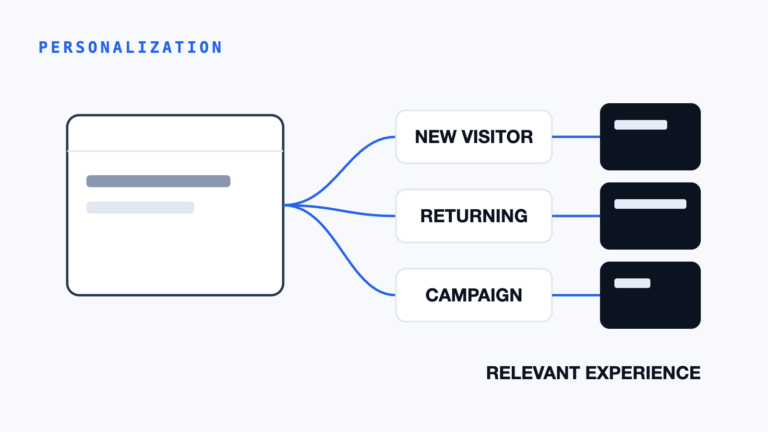
A large enough, distinct enough visitor segment where a different experience is genuinely more useful to them, not just different for its own sake. Returning customers who’d rather skip an introduction they’ve already seen. Visitors from a specific campaign who arrive expecting a specific message. Visitors on mobile who need a shorter path than desktop visitors can tolerate. Each of these is a real, observable difference with enough volume behind it to justify building for it, the opposite of personalizing because a platform makes it possible.
Score your candidate segment before you build for it
Score a candidate segment 0 to 2 on three things: how often it shows up, how differently it behaves, and how big a fix its funnel already needs. This turns “does this feel like a good segment” into a checkable number instead of a hunch.
- How often does the segment show up? 0 = rarely, you’d struggle to name five real examples from the past month. 1 = occasionally. 2 = consistently, every week or better.
- How differently does it actually behave? 0 = no measurable difference from everyone else. 1 = a mild, plausible difference. 2 = a clear, repeatable behavior gap.
- Does the underlying page or funnel already work reasonably well for everyone? 0 = no, most visitors, regardless of segment, still drop off, fix that first. 1 = partially. 2 = yes, the baseline experience already converts decently.
A score of 5 or 6 is a real candidate worth building for. A 2 or lower means either the segment isn’t real yet or the underlying page needs fixing first, not a personalized version of it.
A simple illustration
Picture a mid-sized service business (hypothetical) getting steady traffic split roughly evenly between new visitors and returning customers, each behaving noticeably differently once you look. That’s a real, large-enough segment difference, a strong candidate for personalization. Now picture the same business six months earlier, before it had meaningful traffic at all: the same segment split would have been too small and too noisy to act on. Same business, same idea, different point in its growth, only one of those two moments was actually the right time.
The point is that “worth it” is a question about volume and pattern, not about whether the idea sounds good.
Frequently Asked Questions
Can I test personalization on a small segment just to see if it’s worth it?
You can, but treat the result carefully. A small segment can show a false signal purely by chance, the same risk a low-traffic A/B test runs. A quick test can be a useful directional check, but don’t treat a result from too small a sample as proof either way.
Does “not worth it yet” mean never?
No. It means not yet, given your current traffic and data. As traffic grows, segments that were too thin to act on can become large enough to justify building for. The threshold is about your current volume, not a permanent verdict on your business.
How do I know if my segment is actually “large enough”?
There’s no single number that applies to every business; it depends on how often the segment appears and how big a difference you’re trying to detect. A useful gut-check: if the segment shows up rarely enough that you’d struggle to name five real examples from the past month, it’s probably not large enough yet.
Continue based on what you need next
- Your funnel still loses most visitors regardless of who they are: fix that first, see where your funnel actually leaks for how to find the leak before segmenting anything.
- You’re not sure your traffic is large enough yet: revisit the scorecard above once you can point to a segment with consistent, weekly volume.
- You’re past the threshold and ready to start: personalization with tools you already have is the low-cost place to begin.
- You want the full picture of what personalization is and isn’t: see the plain-language personalization guide.
- You want the underlying pattern behind this threshold question: the Practitioner Lesson Personalization Should Improve a Decision, Not Just Prove the Technology Works.
Start with a free assessment: we’ll give you an honest read on whether personalization is your next move or a distraction from something that would help more.
Alex’s Perspective
Across 7,000+ experiments and personalization experiences, the segments that looked exciting on a slide almost never survived contact with real volume, “high-value mobile visitors from paid social on Tuesdays” isn’t a segment, it’s a filter with a story attached. The ones that held up were boring and large: new vs. returning, one channel vs. another.
Where this fits
This is a Prioritize gate ahead of Personalize: deciding whether a segment has enough real volume to justify building for it, before any experience gets built.
Alex Harris leads AlexDesigns, and this threshold question is usually the first honest answer a prospective personalization client gets from us, sometimes “not yet.” Last reviewed 2026-07-18.