
It was the summer of 2000, in South Florida. I already had a job lined up. Start date and everything, settled for weeks.
Then a friend told me I needed to go check out a startup he’d been talking to. I didn’t want to. I remember being genuinely annoyed about it, like he was making me late for something that mattered more than whatever he was so excited about.
I went anyway.
I walked in expecting to politely say no. About twenty minutes into that conversation, I walked out wondering why I’d ever thought the other job was the right call.
I couldn’t have told you why, exactly, not that day. I just knew the thing in front of me was more interesting than the thing I’d already agreed to. So I took it, and never looked back at the other offer.
That decision is the actual doorway into everything I do now. Not the framework I’d eventually build a name for, that came much later.
Just someone who almost said no to the thing that changed my life because he’d already committed to something smaller.
Looking back, I don’t think I was choosing a company that day.
I think I was choosing a different way of learning. I just didn’t have the words for that yet.
That’s why I’m starting Wins & Lessons. Not because I think the number of years is the point, but because I keep noticing that the moments that actually shaped how I think rarely looked important at the time.
Where the Habit Started
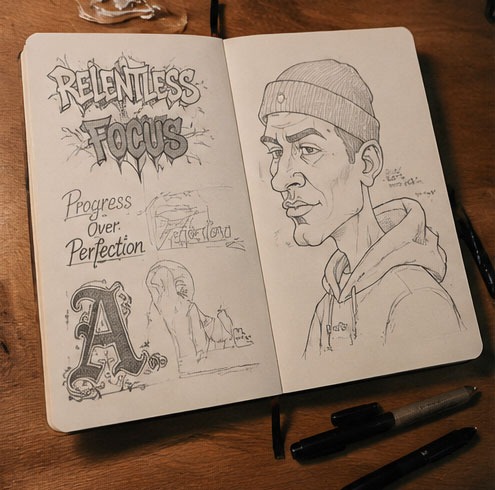
Before any of that, back when all I wanted was to figure out how to make a living creating things, I was a quiet kid who drew constantly: graffiti-style lettering, caricatures of whoever was around, whatever a skate deck graphic or a hip-hop record cover made me want to try copying that week. My mom used to joke I was almost mute as a kid because I said so little. I said plenty on paper.
Skateboarding ran alongside all of it. Like a lot of kids in the late ’80s and early ’90s, I wanted to skate like Steve Caballero and the rest of the Powell Peralta team, that specific way he made a vert ramp look like it wasn’t even trying to throw him off. I never got close. I fell constantly. Not gracefully, not the way that looks good in a video, I mean actually falling, wrist first, more than once, learning something in my body each time that no one had explained to me in words.
None of that felt connected at the time. Drawing happened at a desk. Skating happened at a park with older kids who could already do everything I couldn’t. Different rooms, different rules, nothing in common except me, doing the same thing in both places without noticing it was the same thing: try, miss, feel exactly what went wrong, go back and try again.
I wouldn’t have a name for that instinct for a long time. I just kept using it. You might have your own version of this, a skill you were sure belonged to one part of your life that was quietly teaching you how to handle another. Mine followed me straight into my first real job.
The Medium Kept Changing
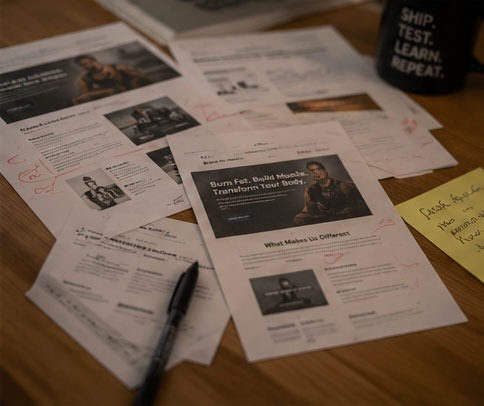
That startup was a diet and fitness company, and my first real job there was building HTML email newsletters that pushed traffic to landing pages. I built everything on a Mac. It looked exactly right, clean, centered, exactly what I’d pictured.
Then it went out to actual inboxes, and on many PCs, half of it was missing.
People made fun of me for it. Not cruelly, more like the way you rib someone for something everyone secretly gets wrong too. But underneath the joking I remember the specific feeling: the floor tilting a few degrees. I’d been so sure it was done. I’d been treating “finished” and “correct” like they were the same thing. They weren’t.
So I’d open it again. Find the thing that only worked on my machine. Fix it. Send it back out. Something else would break somewhere else. I did that more times than I could count before I stopped being frustrated by it and just started working through it, same feeling as the ramp, just with a different kind of wrist injury.
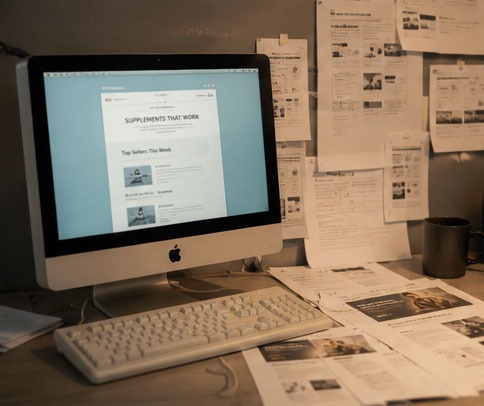
Our office had landing pages taped up on nearly every wall, printed out, marked up in pen, replaced the second something tested better. We were buying AOL welcome screens and pushing large volumes of visitors through those pages, sometimes updating them more than once a week. It looked chaotic. It was actually the opposite.
That job is where I actually learned marketing and technology were part of the same problem. We didn’t call what we were doing “conversion optimization” yet. We just knew broken things had to get fixed, and fixed things had to get tested, or you were only guessing. Fixing what was obviously broken turned out to be the easy part. It was the pages that already worked, the ones I was proud of, that caused me the most trouble.
The First Time Data Proved Me Wrong
Once I’d been at it a while, I got attached to a version of a page I was sure was winning. I could feel it, the copy was tighter, the flow made more sense, it just felt like the one.
Someone I worked with, an analyst who actually understood the statistics I was eyeballing, looked at the same numbers and told me I was wrong. Not “maybe” wrong. The lift I thought I was seeing wasn’t real once you accounted for the sample size.
I didn’t love hearing that. I don’t think anyone does, the first time. But it changed something permanent in how I looked at every page after that one.
That’s the moment data stopped being a tool I used to prove myself right and started being the thing that kept me honest when I was sure I already knew the answer. Staying honest with myself became the whole discipline. Years later, something came along that made it faster.
What AI Actually Changed
For years, I could sketch an experience, explain exactly how it should behave, and work with a developer to build it. What I couldn’t always do was cross the whole distance from idea to working prototype on my own, at the speed I wanted. So a specific kind of idea just stayed an idea, sketched in a notebook, waiting on someone else’s time and budget before it could become anything real.
When I began using Claude to prototype ideas, mostly out of curiosity, I described one of those old sketches out loud. Then I watched it start to take shape. Not perfectly. Not without me steering it constantly. But shape, something I could poke at, break, fix, question, actually learn from instead of only imagine.
I didn’t believe anything differently that day than I had years earlier when I first sketched it out. What changed was that I could finally get from a sketch to a working prototype I could inspect myself, fast enough to learn from it the same afternoon. Turning that prototype into something production-ready still takes specialists, and it still should. What moved was the front of the process, the part where I find out whether an idea is even worth building.
The feeling that surprised me wasn’t excitement about the technology. It was something closer to being that kid again, genuinely not sure I could do the thing in front of me, finding out where my weight was wrong, and going back anyway.
The order still matters. Experience leads. AI accelerates.
Why “Wins & Lessons”
Ask me about the win from that startup job and I’ll tell you about landing pages that started producing real results.
Ask me about the lesson and I’ll tell you about a kid who thought he understood something until it broke on someone else’s computer, or until someone with better math than mine proved my gut wrong.
Those aren’t the same story, even though they came from the same stretch of my life. What I remember most isn’t the wins by themselves. It’s the moment something didn’t hold up, and what I had to go back and figure out because of it.
Some wins taught me almost nothing. Some failures are still teaching me. The ones worth telling are usually both at once.
The Stories I Want to Tell
Some of these stories will be about marketing. Most probably won’t be, at least not directly. There will be more skateboards. Startups. Agencies. Old code. Mentors who changed my mind about something I was sure of. A redesign that went badly wrong. Rooms full of people afraid to be wrong in front of each other. Probably a few things I haven’t figured out how to explain yet.
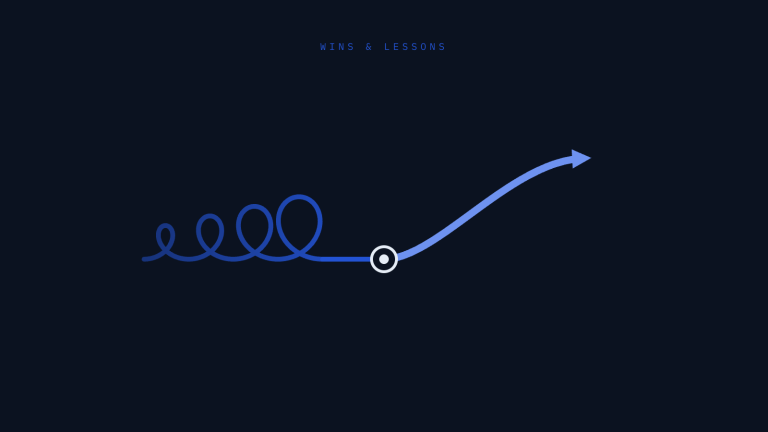
I’m not telling them because the number of years is the point. I’m telling them because the shape underneath them, try, fall, notice, adjust, go back up, is the same shape underneath most things worth getting good at, including whatever you’re working on right now.
If one of these helps you notice that shape in your own work, that’s the whole point.
I still have sketchbooks full of drawings I’d never show anyone now. I still have a faint scar on my wrist I couldn’t tell you the exact date of anymore.
I didn’t have a name for any of this for most of my life.
I do now.