If you already get visitors but too few become customers, the problem usually is not your traffic — it is what happens after the click. Many teams keep paying for more clicks because traffic is easy to measure, while the quiet loss after the click is harder to see. Conversion rate optimization (CRO) is the work of finding and fixing that loss systematically, so more of the visitors you already worked to earn take the next step.
This guide explains what CRO actually is, why so many sites get traffic but not results, and what a serious, ongoing CRO process looks like. It’s written for a business owner, not a specialist — no jargon without a plain-language explanation.
The short answer: CRO improves the percentage of existing visitors who buy, book, request a quote, or become a lead — without requiring more traffic first. It works as a continuous loop: measure, prioritize, build, test, and learn. If you already have meaningful traffic, improving conversion can be a better next investment than buying more clicks because each improvement applies across the traffic you already have.
What is conversion rate optimization, really?
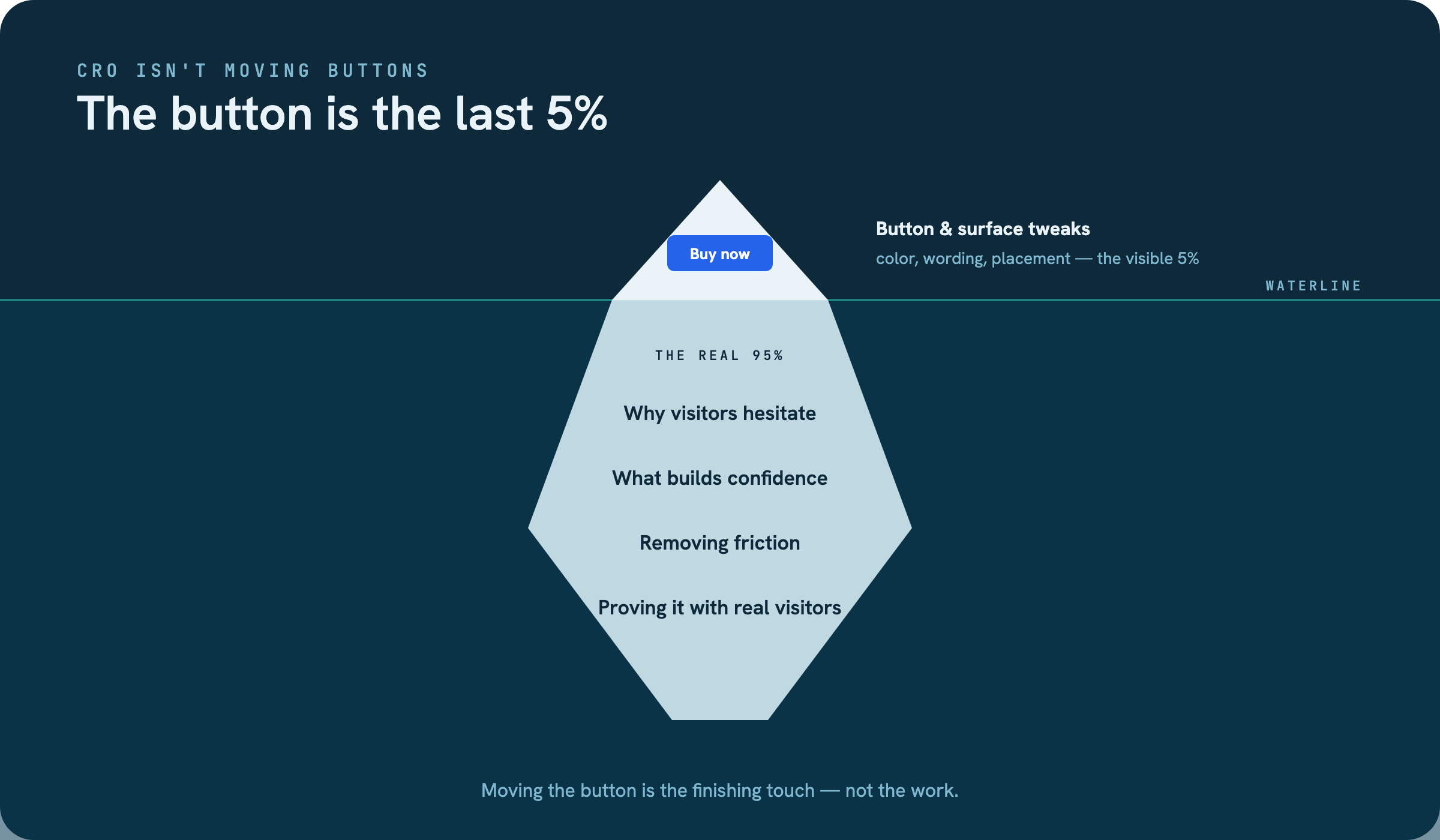
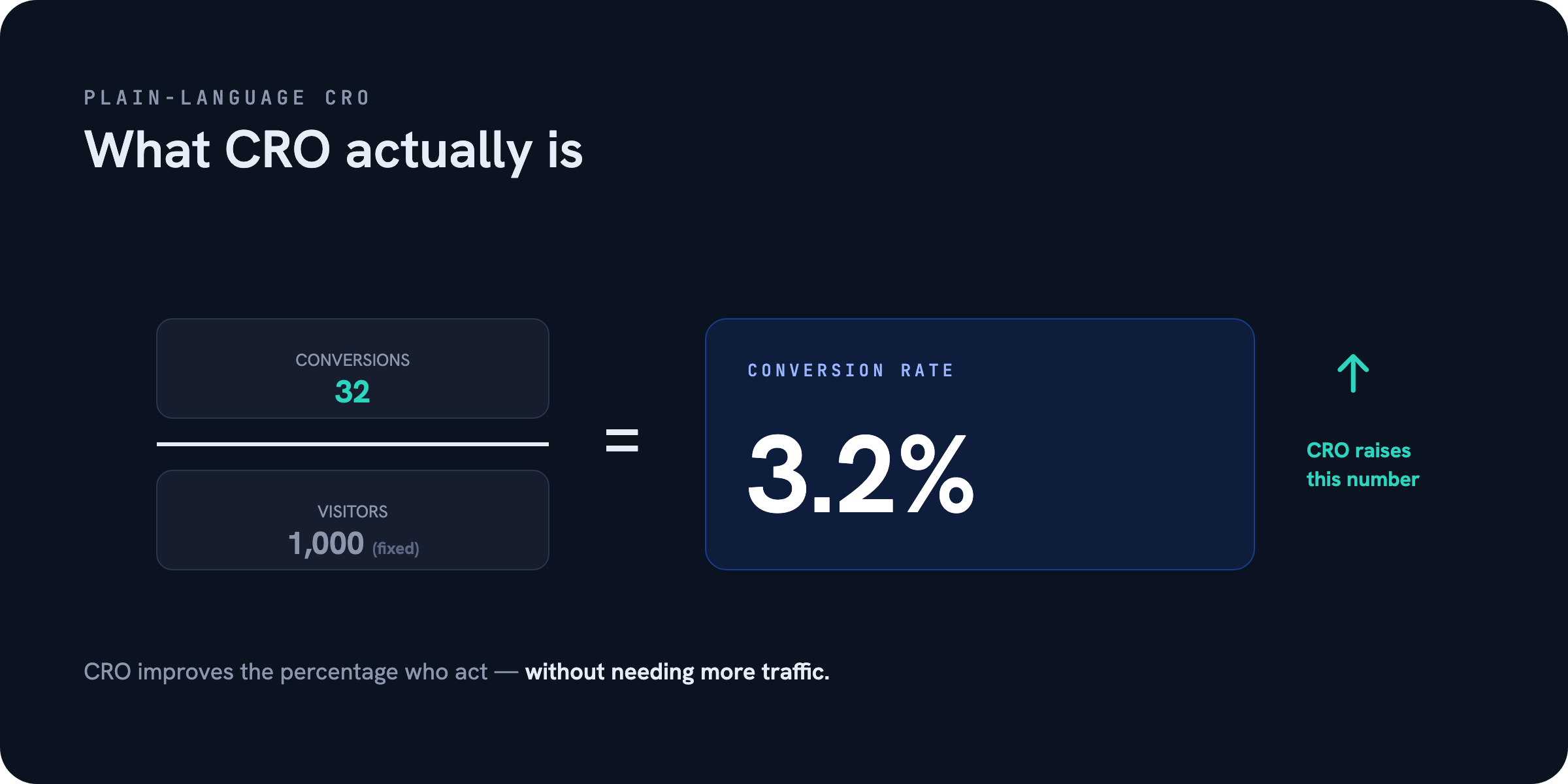
CRO is improving the percentage of visitors who take the action you want — buy, book, sign up, or get in touch — without needing more traffic to do it. Your conversion rate is simply how many people take that action divided by how many visited. CRO raises that number.
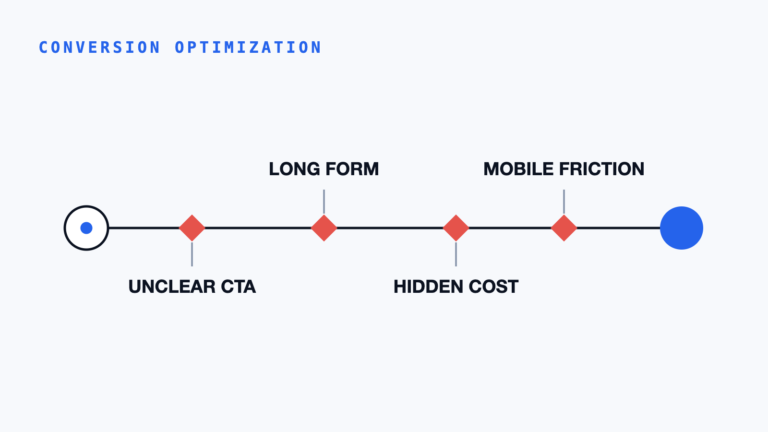
It is not “moving buttons around.” The button is the last five percent. The real work is understanding why visitors hesitate, what they need in order to feel confident, and removing the friction in their way — then proving the change worked with real visitors rather than opinions.
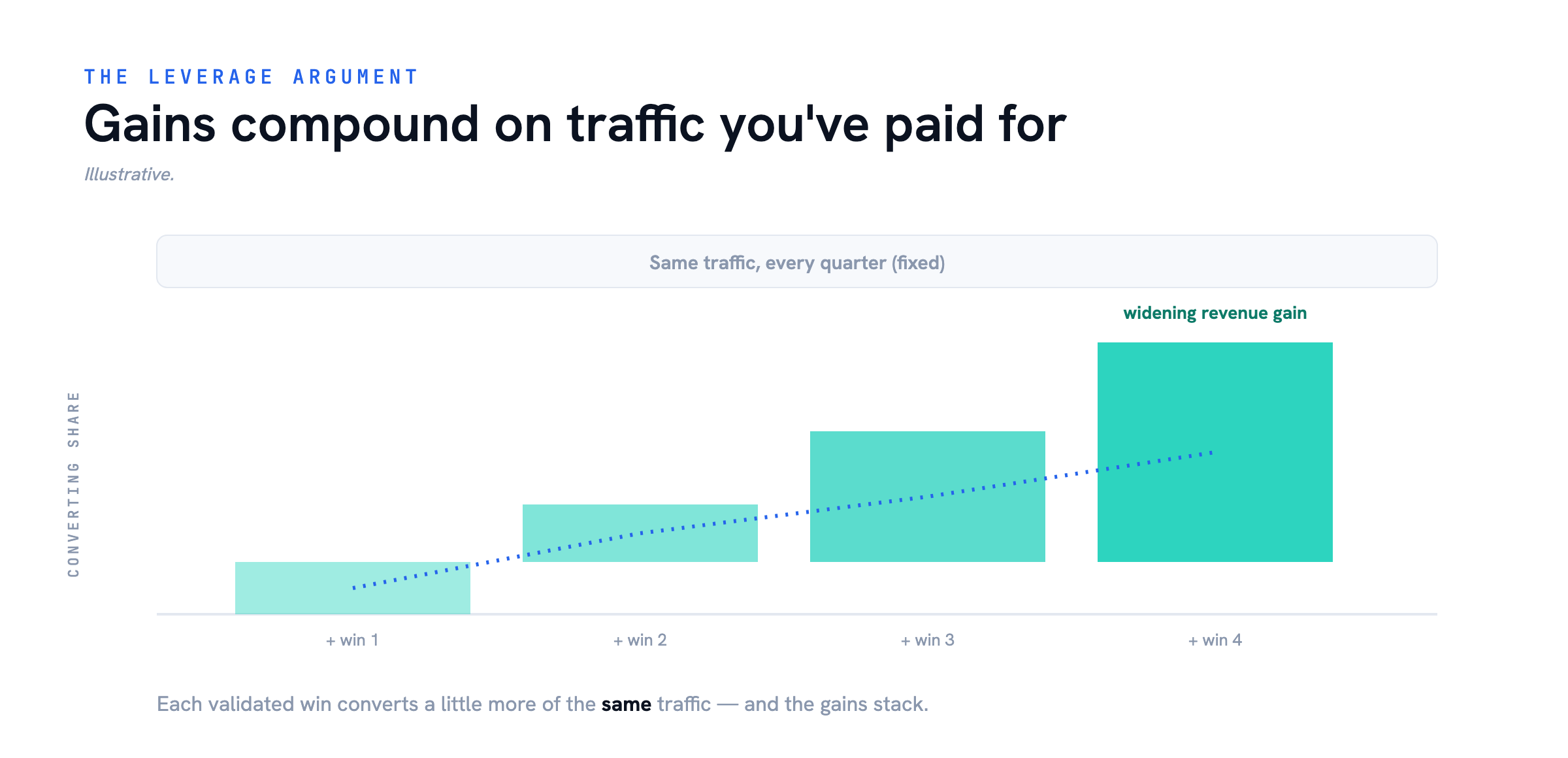
Done well, CRO is one of the highest-leverage things a business with existing traffic can do. Every improvement applies to all the visitors you’re already attracting, so the gains compound on traffic you’ve already paid for.
Why do sites get traffic but still under-convert?
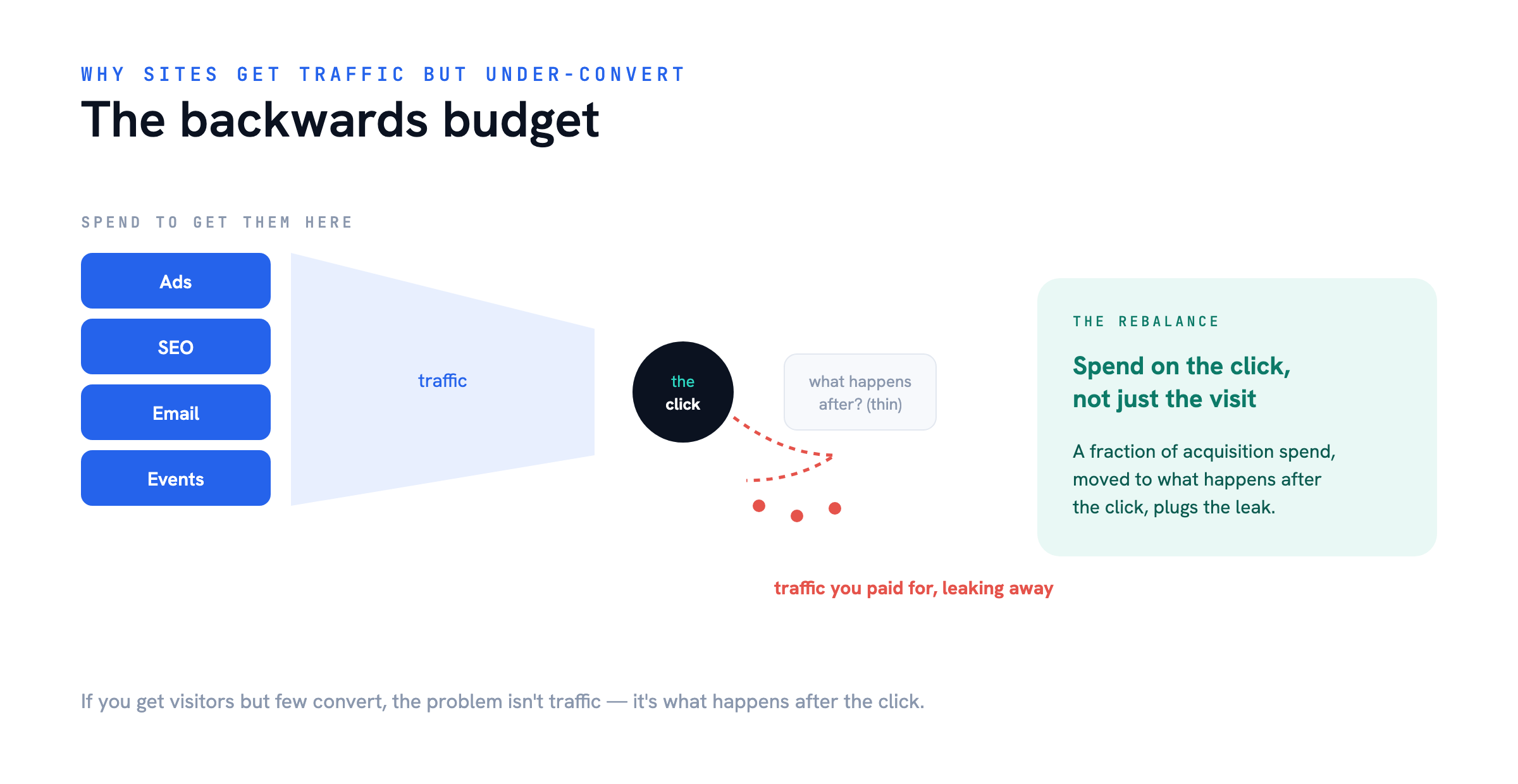
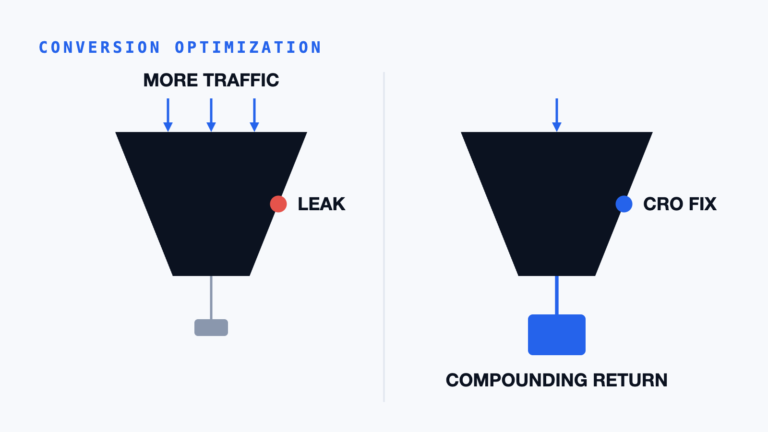
Because almost all the effort — and budget — goes into getting people to the site, and very little into what happens once they arrive. Ads, SEO, email, and events drive the visit. Then the visitor lands on a page that doesn’t quite answer their question, makes them work to find the next step, or fails to give them a reason to trust the business — and they leave.
It’s an easy trap to fall into because traffic is visible and measurable, while the quiet loss after the click is not. The result is that you effectively pay full price for every visitor and collect a fraction of what each one is worth.
There’s usually a second, related gap: most companies already pay for capable tools — analytics, email, sometimes a customer data platform (a CDP, a system that unifies what you know about each customer into one profile your other tools can use) — and barely use them. The data gets collected and never acted on. CRO is also the discipline that finally puts that capability to work.
Is CRO better than spending more on ads?
Often, yes — when you already have traffic — because CRO improves the return on every channel at once, while more ad spend only buys more of the same leaky funnel. If your site converts poorly, sending more paid visitors to it just loses money faster.
The honest version: the two aren’t enemies. Ads and SEO create demand; CRO captures more of it. But if you already have a meaningful audience and a conversion problem, fixing conversion usually pays back faster than buying more clicks — and the improvement keeps paying as long as the traffic flows. If your real constraint is that you don’t have an audience yet, CRO can’t multiply what isn’t there, and a good practitioner will tell you so. For the full decision framework, see CRO vs. more ad spend: which pays off?
What does a real CRO process look like?
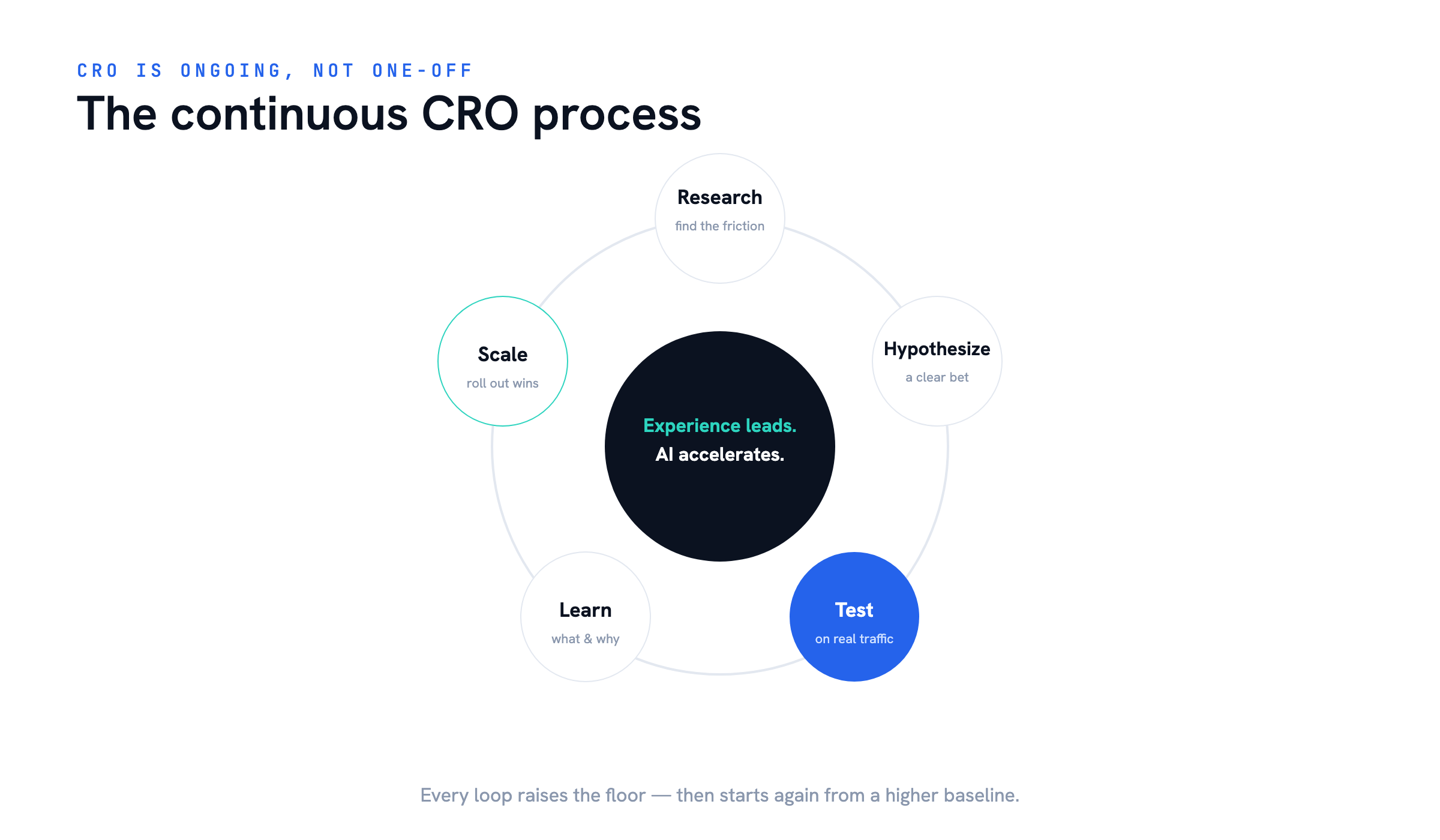
It’s a continuous loop, not a one-time audit. A report full of recommendations can’t test its own ideas; only an ongoing process can. Each cycle looks like this:
- Measure and diagnose. Look at the funnel and analytics to find where visitors drop off,
and form a clear, plain-language hypothesis about why.
- Prioritize. Rank the opportunities by likely impact versus the effort to make them, and
agree on the short list worth doing first.
- Build and ship. Make the change — copy, layout, the flow, the forms, page speed, or
showing more relevant content to different visitors (personalization). Every change is prepared for review before anything goes live.
- Test. Where there’s enough traffic, run an experiment: show two versions to real visitors
and let the results decide (an A/B test). Where traffic is thin, make the evidence-based improvement and watch what happens.
- Learn and repeat. Keep what wins, learn from what doesn’t, and feed it into the next
cycle. The value compounds because each month builds on the last.
This loop is why CRO works best as ongoing retainer work rather than a single project. The list is the easy part; running the loop, month after month, is where the results come from.
What I’d look at first
Before any redesign or new campaign, I look at three things in order. First, the single biggest drop-off in the funnel — not every possible leak, the biggest visible one, because that is where the first useful decision usually lives. Second, the highest-traffic landing page, asking one question: does the first screen answer what the visitor came to find out? Third, the forms and checkout steps, where intent is highest and friction is most expensive.
Many under-converting sites fail one of these three before anything subtler matters. That is why the process starts with diagnosis — how to find what to improve on your website — rather than with a list of best practices.
How long until CRO shows results?
You’ll see work in the first month — diagnosis and the first changes — but reliable results take a few cycles, because trustworthy testing needs enough visitors to be sure. Anyone promising a specific lift on a specific date is selling, not testing.
Here’s the trade-off in plain terms: to trust that a change really helped (and wasn’t just luck), a test needs enough visitors to tell signal from noise. That takes time. The upside is that once a change is proven, the gain is real and durable — not a guess. Patience is part of the method, and it’s a feature, not a delay.
A simple illustration
Picture an online service business (hypothetical) getting steady traffic to its homepage, but few enquiries. A diagnosis might show most visitors never scroll past a headline that describes the company rather than the visitor’s problem. The hypothesis: lead with the problem the visitor came to solve. The test: two versions of the page, shown to real visitors, measured on enquiries. Whatever the result, the business learns something true about its audience — and the next test starts from there.
The method matters more than the specific numbers here: observe, hypothesize, test, learn.
What to do next
If you have traffic and suspect you’re losing too many visitors after the click, start here:
- Look at your funnel and find the single biggest drop-off. That’s usually where the money is.
- Ask, for your highest-traffic page, “does this answer the visitor’s question in the first
screen?” If not, you’ve found a test.
- Decide whether you want to run the improvement loop yourself or have a practitioner run it
continuously.
CRO is not a trick to squeeze more out of visitors. It is the discipline of giving the traffic you already have a clearer path to convert. The teams that improve conversion consistently are not the ones with the longest list of ideas; they are the ones running the loop, month after month.
If you would like a second pair of eyes, find the highest-value leak in your funnel with a free, no-pressure assessment. We will point to the one or two biggest leaks we can already see and tell you honestly whether ongoing CRO looks worth the investment. If it does not, we will say so.
Written by Alex Harris, AlexDesigns. AlexDesigns helps businesses get more from the marketing stack they already own — through CRO, experimentation, personalization, and CDP integration.