“Ongoing conversion rate optimization” can sound vague from the outside: what does a retainer actually do, month after month? Run as a real process, CRO has a concrete monthly rhythm, not an open-ended list of tasks. Here’s what that rhythm looks like, so you know what you’re paying for.
What happens in the first month?
The first month is diagnosis and setup, not testing yet. Before anything gets built or changed, the process starts by instrumenting the funnel properly (making sure analytics, heatmaps, and session recordings are actually capturing the behavior that matters) and then using that data to find where visitors are dropping off and why. That diagnosis turns into a prioritized roadmap: a ranked list of opportunities, ordered by how much impact they’re likely to have versus how much effort they take to build.
By the end of month one, you should have a clear, specific answer to “where is the funnel leaking, and what are we doing about it first,” not a vague promise that things will improve.
What happens in the months after that?
Every following month runs the same loop: build, test, learn, repeat. Once the roadmap exists, the work becomes a steady cadence: prepare and review each change before it goes live, ship it, then either run a real experiment (showing two versions to visitors and letting the results decide) or make the evidence-based improvement directly where there isn’t enough traffic to test formally. Each cycle’s results, win, loss, or flat, feed directly into what gets prioritized next, so the roadmap keeps evolving instead of going stale.
This is also where personalization tends to enter the picture: once the biggest one-size-fits-all improvements are in place, showing more relevant content to different kinds of visitors becomes the next layer of gain.
What do you actually see each month?
Every monthly report answers three questions, shown below.
A short, concrete report (what shipped, what it did, and what’s next), not a wall of vanity metrics. Expect three things on a predictable cadence: a summary of what was built or tested that month and why, the honest result (including the tests that didn’t win, since those are still useful information), and the updated priority list for what’s coming next. The point is that you should always be able to answer “what did this month’s work actually do” without having to ask. For the honest version of when those results actually start showing up, see how long until CRO shows results?
Why does the process keep going instead of wrapping up?
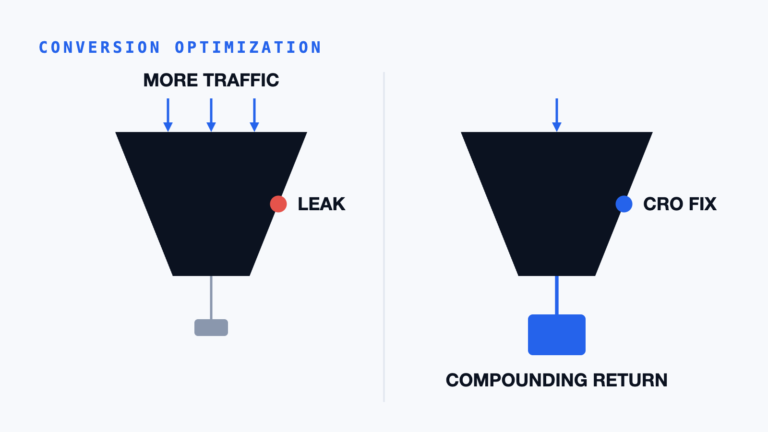
The compounding isn’t magic: it’s this handoff, repeated.
Because each month’s learning makes the next month more effective, and stopping early throws that compounding away. A one-time audit produces a list of ideas nobody tests. An ongoing process tests those ideas for real, learns which ones actually hold up with your visitors, and uses that knowledge to sharpen the next round. The value isn’t in any single month’s win; it’s in the process getting smarter about your specific business over time, the same way the CRO approach itself works as a continuous loop rather than a one-off project.
What to do next
- If you’ve had an audit before but nothing from it actually got tested, that’s the gap an ongoing process closes.
- Ask any CRO provider, including us, what you’d actually receive each month. A vague answer is a warning sign; a specific one (a report, a roadmap update, a results review) is what a real process looks like.
- If you want to see what the first month of diagnosis would surface for your own site, that’s the easiest way to find out whether the ongoing process would be worth it.
Start with a free assessment: we’ll walk through what month one would actually look like for your funnel, with no obligation to continue past it.
Alex’s Perspective
Running this loop across 100+ optimization programs, the retainers that hold up longest are the ones where the monthly report includes the losses, not just the wins. Clients trust the process more, not less, once they see a test that didn’t work get reported plainly: it’s proof the number being reported is real. The retainers that quietly fail are usually the ones where every single month gets reported as a win, which is itself a warning sign, since real testing produces losses on a predictable, regular basis. A monthly report with no losses in it is either testing nothing meaningful or not reporting honestly, and neither is worth paying for.
Where this fits
This is the Prioritize → Experiment → Learn loop running on a monthly cadence: the operating rhythm the rest of the Experience Optimization Framework compounds through, month over month. Every other capability in the framework, from personalization to CDP integration, eventually plugs into this same cadence rather than running on a separate schedule, which is what keeps the whole system coherent instead of becoming a pile of disconnected initiatives.
Alex Harris leads AlexDesigns’ retainer engagements, running this exact monthly rhythm for every active CRO client. What you’d get on a real retainer is what’s described above, not a marketing version of it, and any figure in this piece traces to a named source or is labeled illustrative.