Conversion rate optimization (CRO) is the ongoing, evidence-based practice of improving a digital experience so more of the right visitors complete a valuable action, without sacrificing the quality or downstream value of that outcome. It uses research, behavioral evidence, prioritization, experimentation, and measurement to decide what should change and whether that change actually helped. In plain terms: figure out why visitors hesitate, then make and test changes that address that reason, rather than guessing. Because it works on visitors already arriving, it can raise revenue, leads, or signups without spending more on traffic.
“CRO” gets used loosely, sometimes for a redesign, sometimes for vague “growth” work, sometimes for a single test someone ran once. For the operating model behind it, see Optimization Is a Decision System, Not a Redesign Project.
CRO is a decision discipline, not a collection of optimization tactics. Research surfaces where visitors hesitate; prioritization decides which opportunity to act on first; testing checks whether a specific change actually helps; learning captures what was found so the next decision starts smarter. Any one of those alone isn’t CRO, running them as a connected discipline is.
Key takeaways
- CRO is a decision discipline, not a collection of optimization tactics.
- A/B testing is one tool CRO uses, not the whole discipline.
- A redesign can be part of CRO when it’s evidence-grounded and validated, otherwise it’s just a redesign.
- CRO is more specific than growth: growth covers acquisition, activation, retention, monetization, and referral; CRO is the piece focused on the experience visitors are already in.
- The goal is a valuable completed outcome, not just a percentage moving.
What counts as a conversion?
A conversion is whatever completed action is genuinely valuable: a purchase (ecommerce), a qualified demo request (B2B), an activated account reaching real first use, not just registration (SaaS), a renewed enrollment (membership), a booked consultation (service business). Not every click deserves the label: a newsletter signup can be worth tracking without counting as equivalent to a purchase or qualified lead.
How is conversion rate calculated?
Conversion rate is completed actions divided by eligible visitors, expressed as a percentage. The denominator matters: a useful one excludes visitors who couldn’t realistically convert (bots, an unserved market, people who already converted), not just raw traffic. Against a bloated denominator, the rate looks worse or better than the real opportunity, either way the wrong decision follows.
Is CRO the same as A/B testing?
No. A/B testing is one tool CRO uses to reduce uncertainty about a specific change, not the whole discipline. A well-run test estimates the causal effect of a change under the conditions of that experiment: what happened when you made this change, not that it works everywhere. Below a trustworthy sample size, the mix shifts toward usability research, interviews, technical evidence, and behavioral analysis instead, with larger changes evaluated over a longer window. Still CRO, just evidence gathered through a method suited to the traffic available.
CRO vs. redesign, and CRO vs. growth
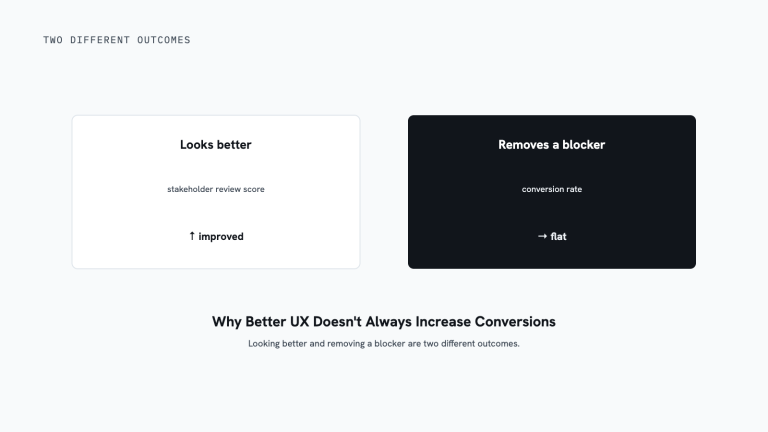
A redesign describes scope, how much of an experience changes at once. CRO describes decision discipline, how a change gets decided and validated. A redesign can be part of a CRO program when it’s evidence-grounded and validated before or after it ships; size doesn’t determine whether something is CRO, whether evidence, not taste alone, drove the decision does. A redesign done on instinct and a redesign done on evidence can look identical at launch, the difference only shows up in whether anyone can say what actually changed visitor behavior.
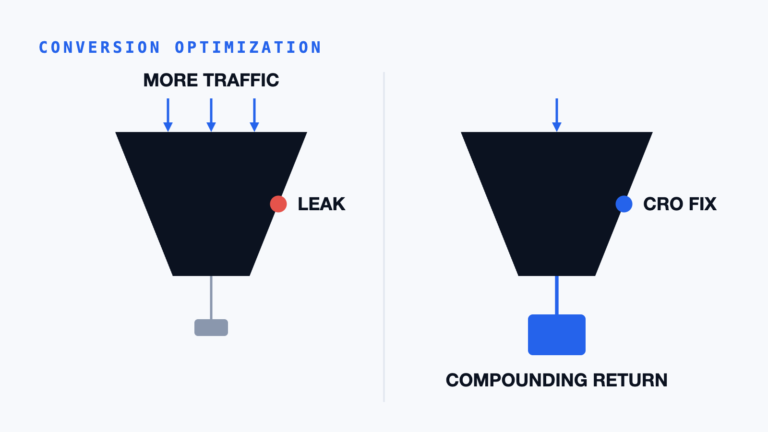
“Growth” is broader than CRO: it spans acquisition, activation, retention, monetization, and referral, the full set of levers that grow a business. CRO is the piece focused on what happens once a visitor is already in the experience, whichever lever brought them there. They’re different levers, not competitors, and a program that confuses them will misdiagnose a traffic problem as a conversion problem, or the reverse (see CRO vs. more ad spend for when each one pays off).
A pricing-page comparison (Illustrative)
Not CRO: the pricing page’s color, font, and layout all change at once, based on taste, launched to everyone with nothing measured before or after. Nobody can say afterward whether it helped, hurt, or did nothing.
CRO: the billing-language copy on that same page (“billed annually” vs. “billed monthly, save by paying annually”) is isolated and tested against a control, based on evidence that pricing clarity was a real hesitation point, with the result measured before it ships to everyone.
Same page, same team, different discipline: one is a bet dressed up as a decision, the other is a decision genuinely backed by evidence, and only one of them tells you anything you can reuse next time.
Who should prioritize CRO, and who shouldn’t yet
Most sites with a defined goal action have a conversion rate worth understanding. How much opportunity is actually there depends on how much traffic and intent already exist. See how to turn more visitors into customers for how to tell whether that opportunity is worth acting on now.
CRO pays off fastest for a business that already has meaningful, intent-carrying traffic and a real gap between visitors arriving and visitors completing the action that matters. A site with very little traffic, no consistent flow toward a goal action, or an offer or product problem underneath the numbers usually gets more value fixing that first: formal testing needs a real audience to learn from, and no amount of page-level evidence work fixes a demand problem.
Why CRO is iterative
CRO is iterative because visitor behavior, the product, the traffic mix, and competitors keep changing, not because a single experiment can resolve every question about an experience. What holds true this quarter may not hold next quarter, which is why the loop keeps running instead of closing after one pass. Treating one test or audit as the entire program is a common way businesses underuse CRO: not because the method doesn’t work, but because a single test or audit is one data point, not a repeatable process.
The loop that keeps it iterative: Diagnose → Prioritize → Test → Learn → Scale → back to Diagnose. Each stage answers a specific question, what’s broken, what’s worth fixing first, is this specific fix true, what did we learn, and does it deserve more traffic, and feeds the next cycle. The full operating model is in Optimization Is a Decision System, Not a Redesign Project.
Frequently Asked Questions
Isn’t CRO just moving buttons around?
The button is the last, smallest part of the work. The real work is understanding why visitors hesitate before they ever reach it, what they need to feel confident, and removing the friction in their way. A button rewrite without that diagnosis is a guess dressed up as a fix.
Alex’s Perspective
The programs that actually compound treat the decision, not the individual test, as the unit of work: what did we decide, why, and what did we learn regardless of outcome. A win nobody writes down teaches the team nothing reusable; a loss diagnosed properly often teaches more than a lucky win.
What to do next
Want the operating model behind the definition? Next: Optimization Is a Decision System, Not a Redesign Project explains how Diagnose → Prioritize → Test → Learn → Scale works as a recurring operating loop, not a one-time project, and how each stage is gated by evidence from the one before it. It’s the map this definition sets up: once you know what CRO actually is, that article is where you see how the decisions connect and compound instead of resetting to zero after every test.
Alex Harris leads AlexDesigns. Start a conversation if you want an honest read on whether CRO would move the needle for your site.