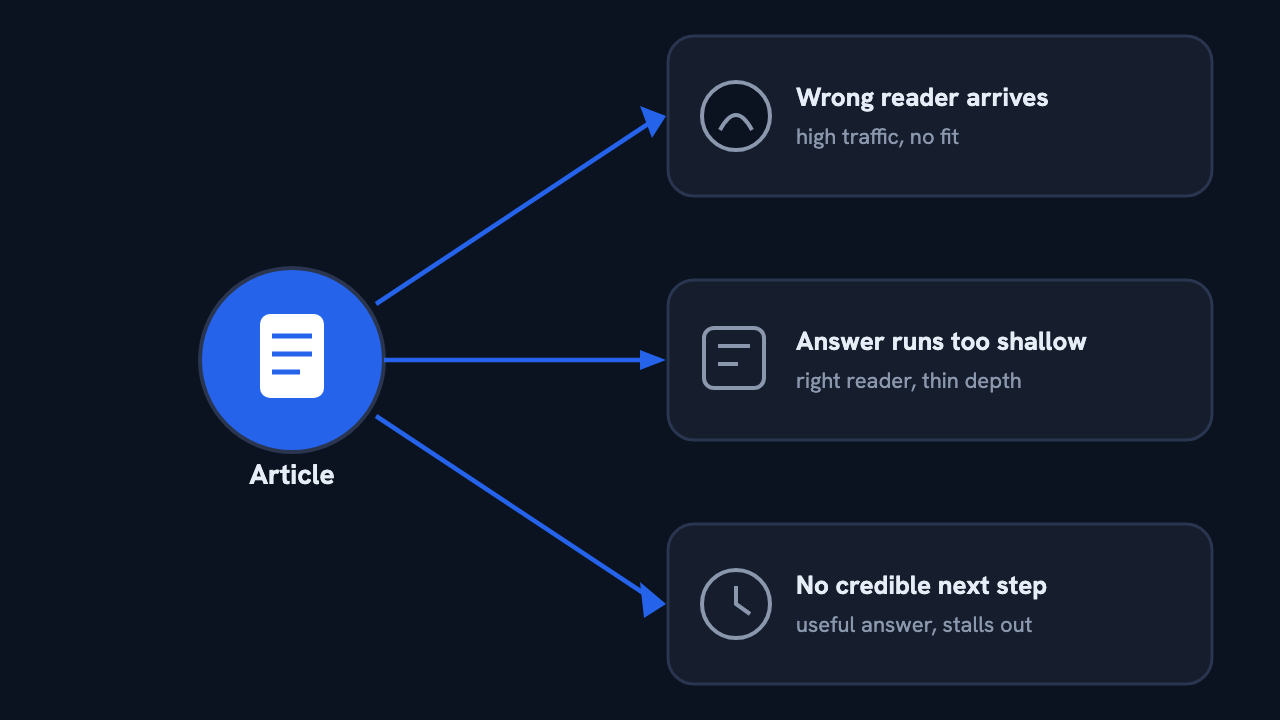
Traffic reaches content but doesn’t convert for one of three reasons: the wrong reader arrives, the right answer is too shallow, or a useful answer has no credible next step. Diagnose which one before adding traffic or rewriting anything.
Three content failures that look the same in analytics
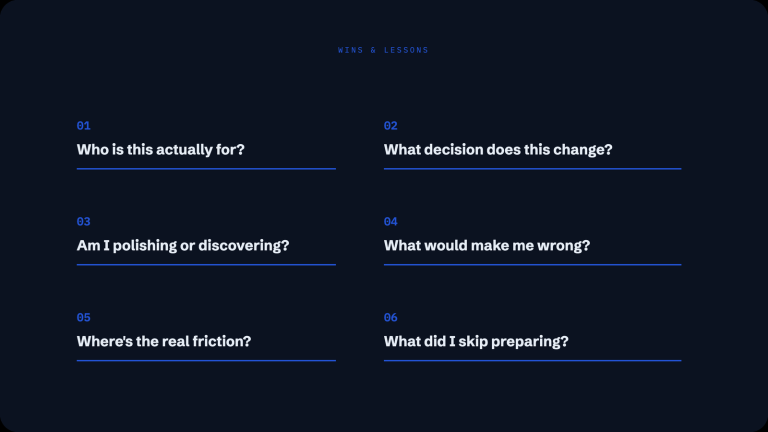
All three failures produce the identical pattern in a traffic report: healthy visits, flat pipeline. That’s what makes them easy to confuse with each other, and it’s why a traffic-only view of an underperforming article almost never points to the right fix on its own. The evidence that tells them apart isn’t in the traffic number at all. It’s in who’s actually arriving, how they engage once they’re there, and what happens after they’ve read the useful part. The model, a comparison for each failure mode, the diagnostic checkpoints, and the sequence a piece should move through are all shown below, and the sections that follow cover each failure mode in enough detail to recognize it on a real article.
Is the wrong reader arriving?
Audience mismatch means the traffic is real, but it was never going to convert. A page written to solve one reader’s specific problem can rank for a broader, more casual search intent that shares the same keywords but not the same buying stage. The traffic looks successful because the numbers are up. It doesn’t convert because the person reading isn’t the reader the piece was written for.
This is easy to miss because engagement can still look healthy. Someone can read the whole piece, even scroll to the end, out of general curiosity rather than a buying problem. High traffic paired with flat pipeline is the signature of this mismatch, not proof the writing itself is weak.
The B2B SaaS example below shows how this plays out: two readers who searched similar terms, headed toward completely different outcomes.
Watch for a query list dominated by informational phrasing rather than evaluation-stage language, a drop-off right after the part that would matter to a practitioner, or a pattern of inbound questions that have nothing to do with the actual offer. If the audience is genuinely useful but will never buy, leave the piece as awareness content and stop expecting it to convert. If the mismatch is closer, rewrite for the buying-stage reader specifically.
Is the answer too shallow for the right reader?
The right person is reading, and the piece still doesn’t resolve their actual question. This looks like an audience problem from the traffic numbers alone, which is why the two get confused. The difference shows up in engagement: a matched reader who bounces quickly is telling you the depth ran out before their question did.
Length isn’t depth. A piece can restate a topic at a competent, generic level and still never answer the one question that determines whether the reader can act. Useful depth means naming the specific decision the reader has to make, not defining the topic more thoroughly. Generic AI-assisted drafting makes this failure more common, not less: a model can produce a fluent answer to the general version of a question without ever reaching the specific edge case that determines what the reader actually does next.
The commercial-contractor example below shows the shape of the gap: a general process explained well, sitting on top of the one constraint that actually determines whether a property manager moves forward.
The depth test: read the piece as the exact reader, and name the question they’d still have after finishing it. That question is the gap. Close it with specific information, not more words.
Is there a credible next step once the answer helps?
The reader gets a genuinely useful answer, and the piece still doesn’t move them anywhere. This is the easiest failure to miss, because everything upstream worked: the right person arrived and got real value. What’s missing is a next step that matches how much they now understand, not a generic CTA dropped in regardless of where the reader actually is.
A single “book a call” button asks a reader who just learned something for the first time to make the same commitment as a reader who’s spent three weeks evaluating vendors. One CTA can’t serve both, shown below.
Two examples (illustrative): an ecommerce article answers the shopper’s question and stops, with no link to the product that would let them act. A B2B comparison article attracts qualified buyers, answers their feature questions, then never addresses migration or onboarding, the exact questions a buyer that far along is now asking.
Watch for strong completion on the content with no click-through afterward, a page that reads well but never appears in the assisted-conversion path, or sales conversations that reference the piece by name with no record of the reader going anywhere after reading it. Match the next step to intent: a reader who just learned something needs a next question to explore, not a sales form.
Diagnose the problem before rewriting the article
Run the piece through a working diagnosis before changing anything. This takes less time than a rewrite and tells you which failure, if any, is actually happening, so the change addresses the real cause instead of a guess.
Step 1: Define the job of the article
Write one sentence: this article should help [specific reader] understand or accomplish [specific task], then move toward [appropriate next step]. If that sentence can’t be filled in specifically, that’s the first problem, before any traffic or engagement number even matters. A vague job statement usually means the piece was written to cover a topic, not to move a specific reader somewhere.
Example: this article should help a growth marketer evaluating whether their content program is working understand the difference between an audience, depth, and progression problem, then move toward assessing their own highest-traffic underperformer. Write the real one for the piece in front of you before moving to step two; the rest of the diagnosis is only useful once this sentence exists.
Step 2: Review traffic source and actual intent
Group the queries actually sending traffic into rough buckets: the intended business problem, broad informational research, student or educational intent, employment-related searches, general consumer curiosity, and anything clearly unrelated. This won’t classify every visitor with certainty, and it doesn’t need to. It will usually make the dominant pattern obvious within a few minutes of reading the real query list, which is often enough on its own to rule failure mode one in or out before looking at anything else. Pull the list from whichever search console or analytics tool is already in use; the exercise works with a spreadsheet and twenty minutes, not a specialized platform, and doing it by hand once tends to make the pattern more obvious than a dashboard summary would.
Step 3: Compare visitors with the intended reader
Where the tools and permissions allow it, look at query language, geography, device, new versus returning behavior, the page before and after this one in the session, account or company information, form field selections, CRM source data, and anything qualitative from sales conversations that references this piece. No single signal proves audience fit on its own; several pointing the same direction usually does. The goal isn’t a perfect classification of every session, it’s a confident read on the dominant pattern, which is usually enough to decide which failure mode is worth investigating first. Where privacy rules or tooling limit what’s available, a smaller set of signals still works; the point is corroboration across whatever is actually accessible, not completeness for its own sake.
Step 4: Find where the content still makes the reader guess
Read the piece as the intended reader and mark every point where it leaves a real question open: how, which option applies to me, what should I do first, how would I know if this worked, what does this actually look like in practice, what happens if the obvious recommendation doesn’t fit my situation, how do I measure it. Every unmarked question is a depth gap, and most pieces have at least one even when they read as thorough on a first pass; the marking exercise is what surfaces it. Reading the piece out loud, at the reader’s decision point rather than as its own author, tends to surface these gaps faster than a silent read-through does, since a gap is usually the exact spot where the reading gets awkward.
Step 5: Map the next-step sequence
Lay out the progression the piece should build toward: a specific question, a diagnosis, an example, a practical action, the relevant capability, and an assessment. The exact sequence varies by topic and reader intent; not every piece needs all stages spelled out explicitly, but every piece should end somewhere specific rather than stopping flat once the useful information has been delivered.
Step 6: Make one controlled improvement
Resist changing audience targeting, depth, and the call-to-action all at once. If all three change together, a result a month later won’t say which change actually mattered, and the next article won’t benefit from what was learned. Fix the one failure the diagnosis actually found first, then measure before touching anything else about the piece. This is the single hardest discipline in the whole process, because once the copy is open for editing, every small unrelated improvement looks free. None of them are free once they’re mixed into the same measurement window, and the next diagnosis inherits the confusion the untracked change left behind.
Step 7: Measure the complete journey
Track more than the article’s own traffic: qualified entrances, engagement and section completion, progression through internal links, visits to relevant case studies or capability pages, assessment starts, return visits, assisted conversions, lead quality where it’s traceable, and whether sales references the piece in conversation. A single article rarely produces an immediate direct conversion on its own; what it can do is move a reader a real step forward, and that step is measurable even when the final conversion happens somewhere else in the journey. Give the new version a specific window before judging it, long enough for a real sample of the intended reader to actually pass through, and write that window down before the change ships rather than picking a convenient stopping point after the fact.
Score the article before promoting it again
Score the piece honestly across six areas before sending it more traffic: audience fit, intent fit, depth, differentiation, next step, and measurement. Two people on the same team scoring the same article independently should land within a point or two of each other.
| Area | 0 | 1 | 2 |
|---|---|---|---|
| Audience fit | Mostly the wrong reader | Mixed audience | Matches the intended reader |
| Intent fit | Wrong search intent | Adjacent intent | Matches buying-stage intent |
| Depth | Surface-level only | Resolves the common case | Resolves the specific decision |
| Differentiation | Interchangeable with competitors | Some unique detail | A distinct, specific point of view |
| Next step | No next step, or one generic CTA | One next step for every reader | Next step matches reader intent |
| Measurement | Only traffic is tracked | Engagement is tracked | The full journey is tracked |
A total of 10 to 12 means the piece is doing its job; promote it and keep watching what the traffic teaches you, and treat a high score as a pattern worth copying in the next piece. A 7 to 9 means one clear weak point; fix that specific area before scaling traffic further, and resist touching areas that already scored well while you’re in there, since an untracked extra change makes the next measurement useless. A 0 to 6 means something structural is off; diagnose which failure mode is happening using the seven steps above rather than guessing from the low score, since the total says a problem exists without saying which one it is.
What not to do first
Most of the actions a team reaches for first make sense on their own and are still wrong here, because each one assumes the failure is already known. They aren’t wrong in general. They’re wrong as a first move, before the diagnosis has actually named which failure is happening.
- Don’t chase more traffic before the diagnosis is done; more visits to a mismatched or shallow page just produce more traffic that doesn’t convert, at a larger scale.
- Don’t add several unrelated calls-to-action hoping one of them lands.
- Don’t increase paid promotion behind a page that hasn’t been diagnosed.
- Don’t publish a generic supporting article as a workaround for a specific gap in this one.
- Don’t expand the word count before finding the actual information gap; length without a target question doesn’t add depth.
- Don’t judge the piece by traffic alone; traffic is the metric that hides all three failures equally well.
- Don’t change every variable at once; one controlled change is the only way to know what worked.
What to do next
Pick one high-traffic article that isn’t contributing to a real outcome and run it through the seven-step diagnosis above this week, start to finish, on that one piece rather than the whole library at once. Score it against the six areas before touching a word of the existing copy, so the before-and-after comparison means something. Make the one change the diagnosis actually points to, not the change that happens to be easiest to ship. Set a specific measurement window before promoting the piece again, and check the full journey the article feeds into, not just its own traffic number.
The larger lesson
Content conversion isn’t only a copy problem. It’s an experience problem, and copy is only one piece of it.
The full list runs from what a reader searched for, to whether the content matches that intent, to whether the answer goes deep enough to be useful, to whether the piece supports a real decision, to what happens the moment the reader is done, to whether any of it is measured well enough to learn from. Fixing the copy without checking the other five rarely moves the number that actually mattered, which is why a rewrite is so often the wrong first move: it treats a five-part problem as if only the first part existed. The diagnosis above exists to find out which part actually broke, before a rewrite happens in its place.
Not more traffic.
More of the right people making real progress.
Perspectives & Takeaways
The request that starts this conversation is rarely a request to diagnose anything at all.
Across 100+ optimization programs, it’s usually a request for more traffic, asked about a piece nobody has actually read as the intended reader in months. The programs that improve fastest are the ones where someone stops and reads the underperforming piece cold, as the person it was written for, before approving another dollar of promotion behind it. That fifteen minutes of honest reading usually surfaces the failure mode faster than any dashboard does, because a dashboard shows what happened, not why it happened. Teams that run this diagnosis once tend to keep running it, because it’s faster than a rewrite and right more often than the instinct that would have guided the rewrite anyway.
Where this fits
This is a Discover problem before it’s anything else: finding out which of three plausible explanations is actually true, using real evidence, before acting on any of them. Once the failure mode is identified, the fix itself usually sits in Experiment, testing the specific change, and Learn, confirming whether the full journey improved and not just the traffic. Treating a content problem as a Discover question first, rather than jumping straight to a rewrite, is what keeps the fix aimed at the actual cause instead of the most visible symptom.
Alex Harris leads AlexDesigns’ AI Marketing Systems work, where diagnosing whether existing content is doing its job comes before any conversation about producing more of it. The honest answer is sometimes “this article is fine, it just isn’t your priority,” even when a rewrite would have been the easier thing to recommend.