Last week I was standing on a stage in New York under a light that felt approximately six inches from my forehead.
It was bright. I was sweating. Everyone was looking at me.
And for about the first two minutes, I wasn’t exactly sure what I wanted to say.
Which was ridiculous, because I had prepared for this presentation.
A lot.
I had worked on the demo. Then worked on it some more. I knew what I wanted to show. I had thought about the conversations I wanted to have while I was there. I knew the technology. I knew the subject. I knew where I wanted the presentation to eventually go.
What I hadn’t really practiced was the beginning.
The part where everyone stops talking, looks at you, and waits for you to give them a reason to pay attention.
Luckily, my boss was on stage with me. She helped get us moving. I eventually found my rhythm, got into the part of the presentation where I knew exactly what I wanted to communicate, and the talk ended up going really well.
People enjoyed it.
But I knew something they didn’t.
I’d optimized the wrong thing.
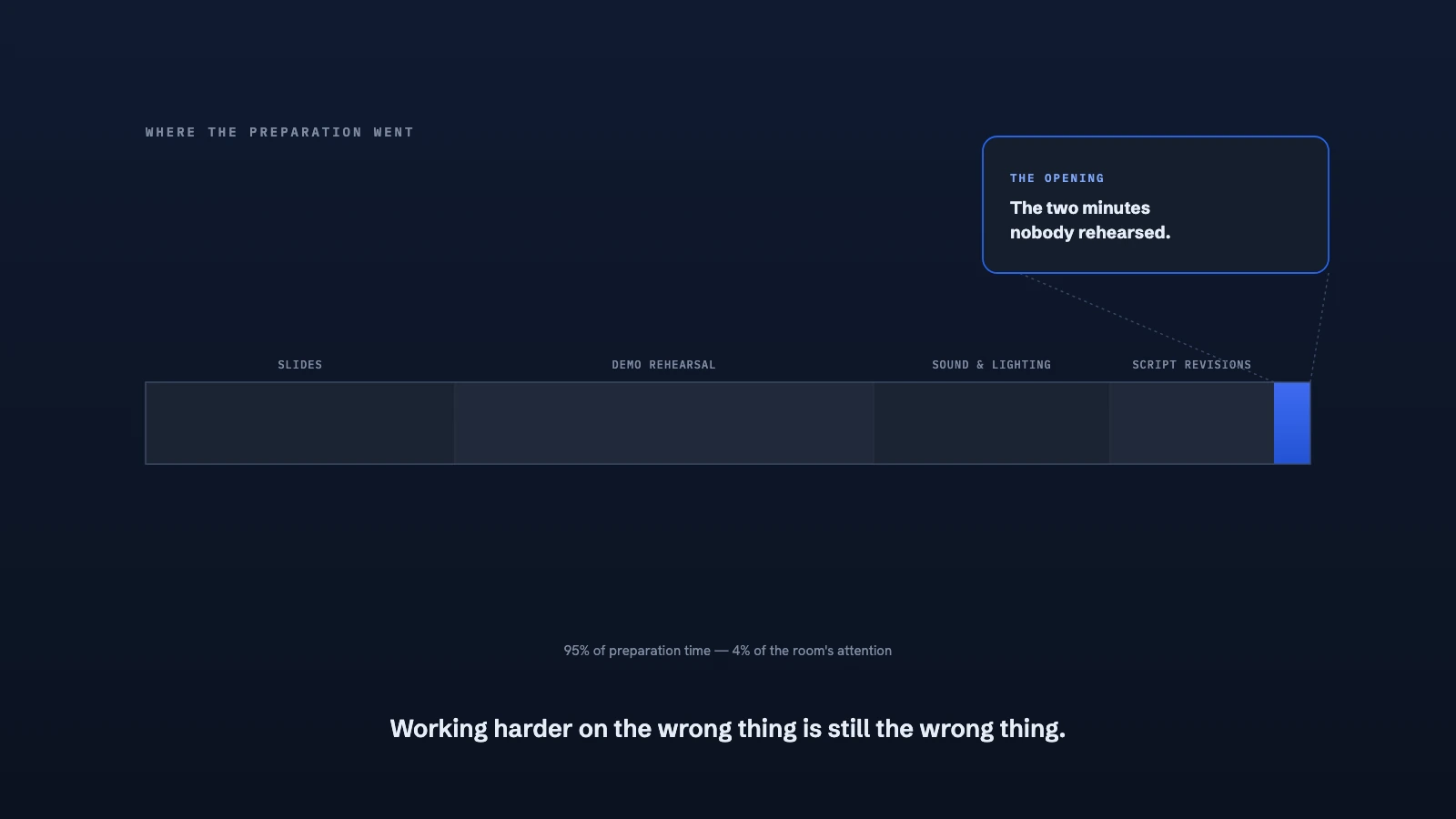
Illustrative timeline: I knew the demo. I hadn’t given nearly enough attention to the first two minutes.
I Had Prepared. I Just Hadn’t Prioritized.
I’m naturally pretty introverted.
I’ve learned over the years that if I’m going to present something well, I usually have to prepare more than somebody who can walk into a room, turn the energy on, and immediately own it.
That’s okay. I know that about myself.
Which is exactly why this bothered me.
I should have anticipated it.
I spend a ridiculous amount of my professional life trying to figure out what could go wrong before it does.
That’s basically what conversion optimization is.
It’s increasingly what I’m doing with AI systems too.
Observe the problem. Understand the constraints. Find the important part. Test something. Learn. Adjust.
Yet somehow, when I prepared this presentation, I spent a disproportionate amount of my time polishing the thing I was already comfortable with.
The demo.
The thing I actually needed to work on was the transition into it.
Once I got there, I was fine.
I hadn’t prepared the doorway.
And I’ve realized I’m doing versions of this in other parts of my life too.
AI Makes This Problem Much Easier to Create
I’ve been building a lot with AI.
And one of the things I love about it is also one of the things I’m starting to distrust about it.
You can build so much.
An idea that once would have required a developer, a designer, a specification and probably several meetings can suddenly start taking shape while you’re sitting at your desk talking to Claude or ChatGPT.
That’s incredible.
It’s also dangerous.
Because every time I use something I’m building, I notice another possibility.
Maybe it needs another feature.
Maybe this screen should work differently.
Maybe the agent should understand something else.
Maybe there should be another workflow.
And because AI makes the next thing feel relatively inexpensive to create, it’s very easy to say:
Sure. Add that too.
I’ve watched projects that were supposed to simplify my work become projects that consume my work.
The problem wasn’t that AI couldn’t build enough.
The problem was that I hadn’t been disciplined enough about deciding what actually mattered.
That’s a very different problem.
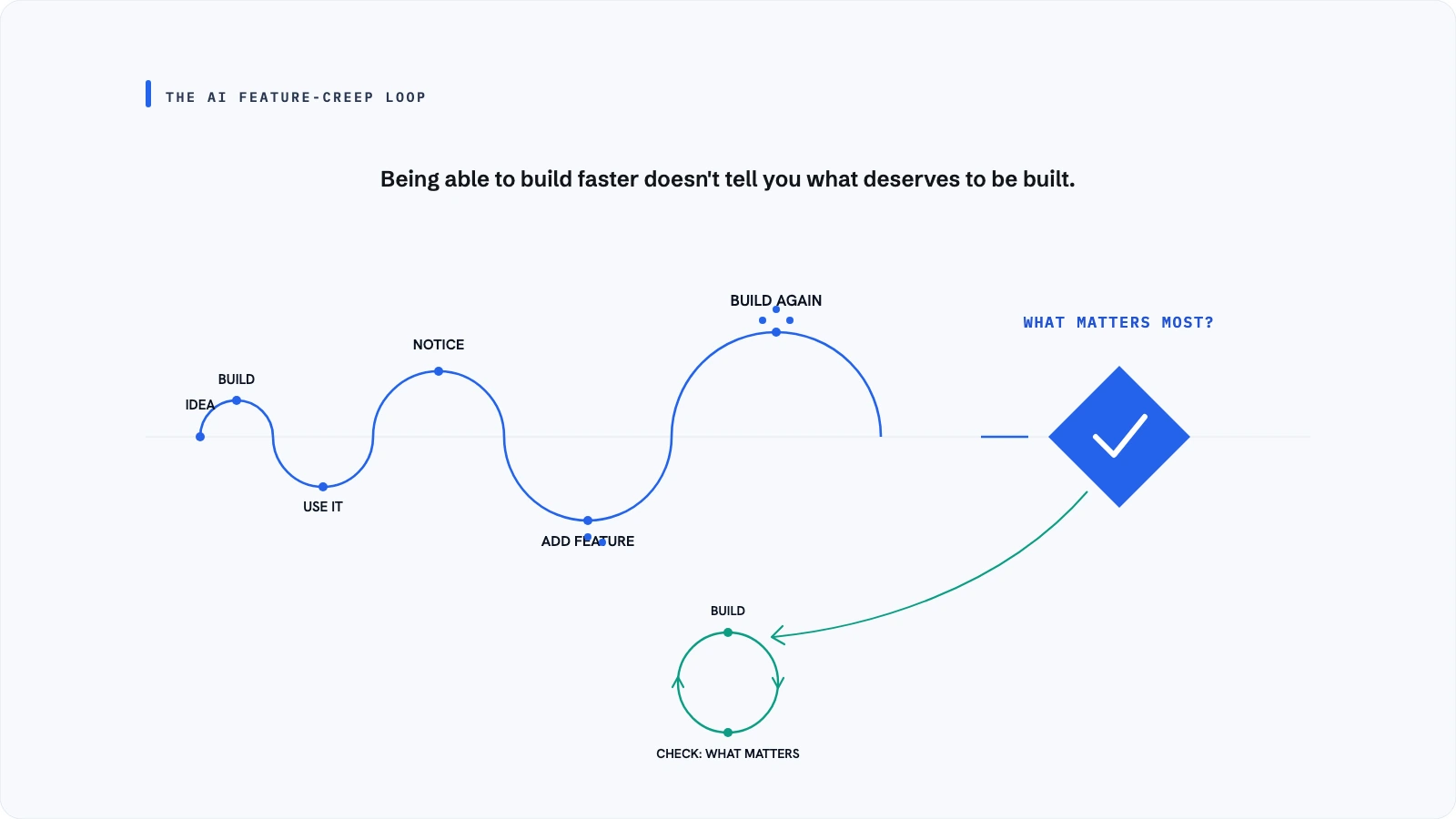
Being able to build faster doesn’t tell you what deserves to be built.
CRO Taught Me This Years Ago
The funny thing is that I already knew the answer.
I’ve spent years doing conversion optimization.
And one of the easiest ways to waste a lot of money in CRO is to start with:
What should we test?
That’s usually too early.
Someone sees conversion dropping and immediately wants to redesign the checkout.
Or change the CTA.
Or simplify the page.
Or launch personalization.
Those might all be good ideas.
But you don’t know yet.
Maybe conversion only dropped on mobile.
Maybe the traffic mix changed.
Maybe returning customers are fine and new customers aren’t.
Maybe the problem isn’t the checkout at all.
You can execute an excellent solution to the wrong problem.
And that’s what clicked for me after New York.
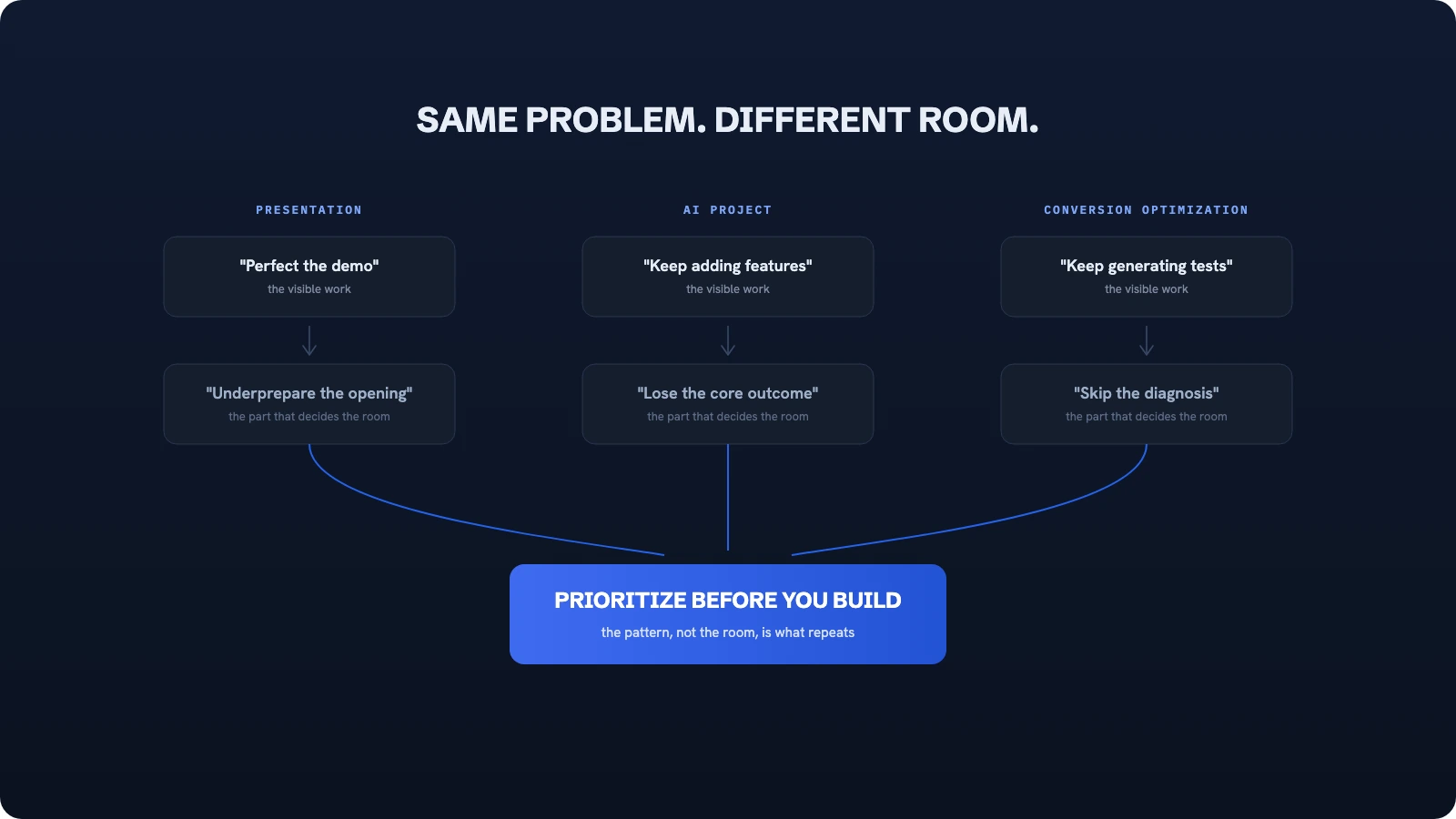
The presentation, the AI projects and the CRO work aren’t three different lessons.
They’re the same lesson wearing different clothes.
Focus has to come before execution.
The Six Questions
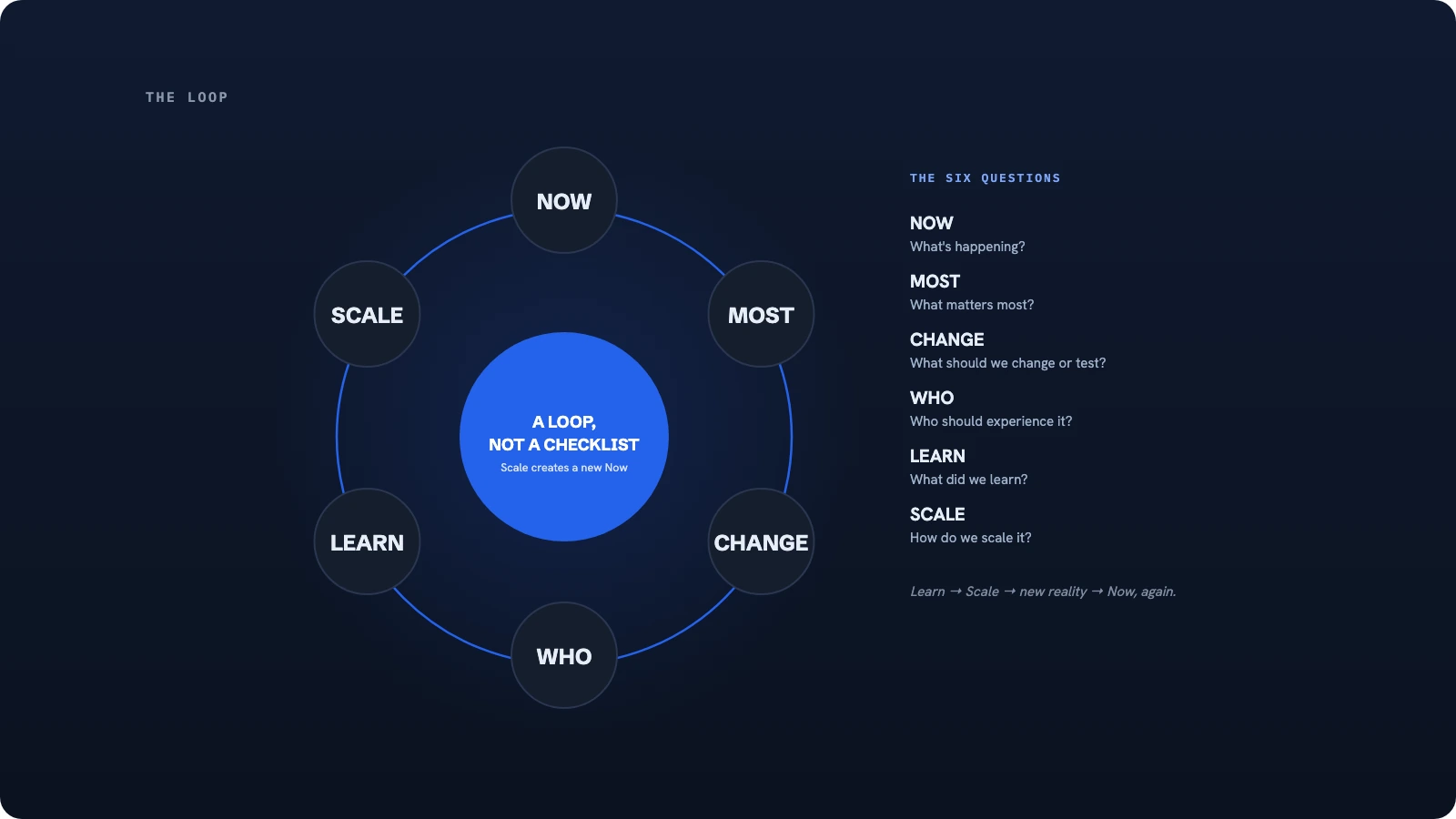
Earlier that day, I was working through something completely unrelated and landed on six questions.
I kept repeating them until I could remember them without looking.
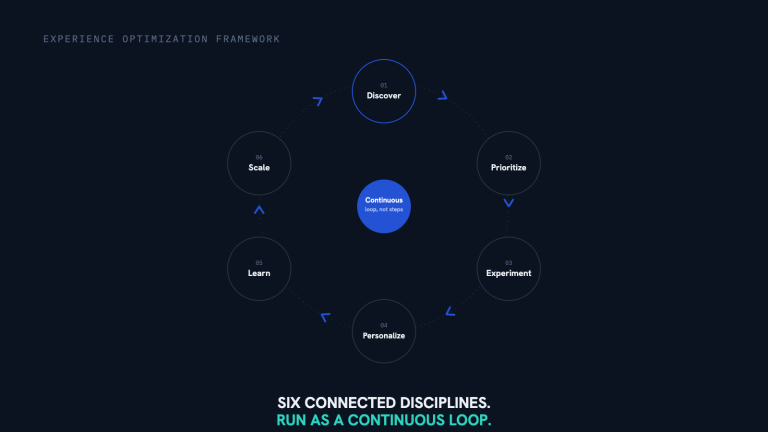
Now. Most. Change. Who. Learn. Scale.
They’re simple enough that I almost dismissed them.
I don’t anymore.
First: What’s Happening?
Start with reality.
Not what you hoped would happen.
Not what the original plan says should be happening.
What is actually happening?
With my presentation, I knew the material but hadn’t prepared the opening well enough.
With an AI project, maybe I’ve built a lot of functionality but the product still isn’t helping me accomplish the original job.
With CRO, maybe revenue is down, but we haven’t established where the problem actually sits.
Until this question is answered, everything that follows is built on assumption.
Second: What Matters Most?
This may be the hardest one.
Because important things compete with other important things.
The demo mattered.
The content mattered.
Meeting people mattered.
But if the first two minutes determine whether people are ready to listen to the next twenty, maybe those two minutes deserve more attention than the tenth revision of the demo.
The same thing happens with AI projects.
There can be twenty legitimate improvements sitting in front of me.
That doesn’t make all twenty priorities.
A list of good ideas is not a strategy.
Third: What Should We Change or Test?
Only now do we act.
This is where I tend to get ahead of myself.
Building feels productive.
Changing something feels productive.
Testing feels productive.
But action without the first two questions can just help you travel faster in the wrong direction.
For my next presentation, the change is obvious: I’m treating the opening as its own deliverable.
Not something I’ll figure out once I’m standing there.
For an AI project, the answer might be freezing additional features until the primary user outcome works.
For CRO, it might be one experiment targeted directly at the evidence we found instead of ten ideas sitting on a roadmap.
Fourth: Who Should Experience It?
This comes directly from personalization and optimization, but I think it’s broader than that.
Who is this actually for?
Who needs this feature?
Who needs this message?
Who is sitting in the audience?
I can understand a topic deeply and still explain it badly if I’m explaining it for myself instead of the person listening.
AI makes this mistake easy too.
We can build sophisticated systems because they’re interesting to build.
That doesn’t mean the person using them needs the sophistication.
Sometimes the most advanced system is the one that makes the complexity disappear.
Fifth: What Did We Learn?
This question is why I’m writing these Wins & Lessons posts in the first place.
Moving on is easy.
Learning isn’t automatic.
The presentation went well.
I could have left New York saying exactly that.
Good presentation. People liked it. On to the next thing.
But then I would have thrown away probably the most useful part of the experience.
The uncomfortable first two minutes told me something the successful next twenty couldn’t.
I had prepared broadly instead of prioritizing sharply.
That’s useful.
Sixth: How Do We Scale It?
This is where a lesson becomes more than a story.
If I simply prepare the next presentation better, that’s useful once.
If I change the way I prepare every presentation, that’s a system.
If an AI project teaches me to define the finish line before adding another feature, I shouldn’t only fix that project.
That rule should travel with me to the next one.
And if an optimization program discovers something meaningful about a customer, that learning shouldn’t die when the experiment ends.
It should influence the next experience.
That’s compounding.
You Can Use This Before Almost Anything
I’m starting to think the value of these six questions is that they don’t really belong to CRO.
Or AI.
Or public speaking.
They’re a way of forcing yourself to think before effort starts masquerading as progress.
Before your next project, take ten minutes and answer them.
Before your next presentation, answer them.
Before adding the feature everyone suddenly thinks you need, answer them.
Before putting another batch of experiments on a roadmap, answer them.
You don’t need a complicated template.
Write this at the top of a page:
NOW What is actually happening?
MOST What matters most right now?
CHANGE What should we change or test?
WHO Who needs to experience it?
LEARN What did this teach us?
SCALE What should we carry forward?
If you can’t answer one of them, that’s probably where you need to spend more time.
The Thing I’m Trying to Get Better At
I’m still going to overprepare.
That’s probably not changing.
I’m still going to build things that become more complicated than they need to be.
I’ll probably still convince myself occasionally that one more feature is the feature that’s going to make everything click.
And I suspect there will be another stage somewhere with an aggressively bright light waiting for me.
The goal isn’t to suddenly stop making mistakes.
It’s to catch the pattern sooner.
That’s really what optimization has taught me.
You don’t become good at this because you always know the answer.
You get better at recognizing when the answer you were sure about isn’t holding up anymore.
Then you adjust.
So next time I walk onto a stage, I’m going to know exactly how the first two minutes start.
And the next time I’m three hours into improving something that was supposed to save me time, I’m going to stop and ask myself six questions.
Now. Most. Change. Who. Learn. Scale.
Because sometimes the thing you’re working hardest to perfect isn’t actually the thing that matters most.
What to do next
Write the six questions at the top of a page before your next presentation, AI build, or CRO plan. If you’d rather talk one through with someone else first, a quick conversation is there when you want it — no pitch attached.
Many of the ideas explored in Wins & Lessons eventually influence how we build AI marketing systems at AlexDesigns, including this six-question framework, which now shapes how we scope client work. Where relevant, future articles will link to those resources so you can explore how these lessons evolved into practical approaches.
Continue Reading: Why I’m Starting Wins & Lessons