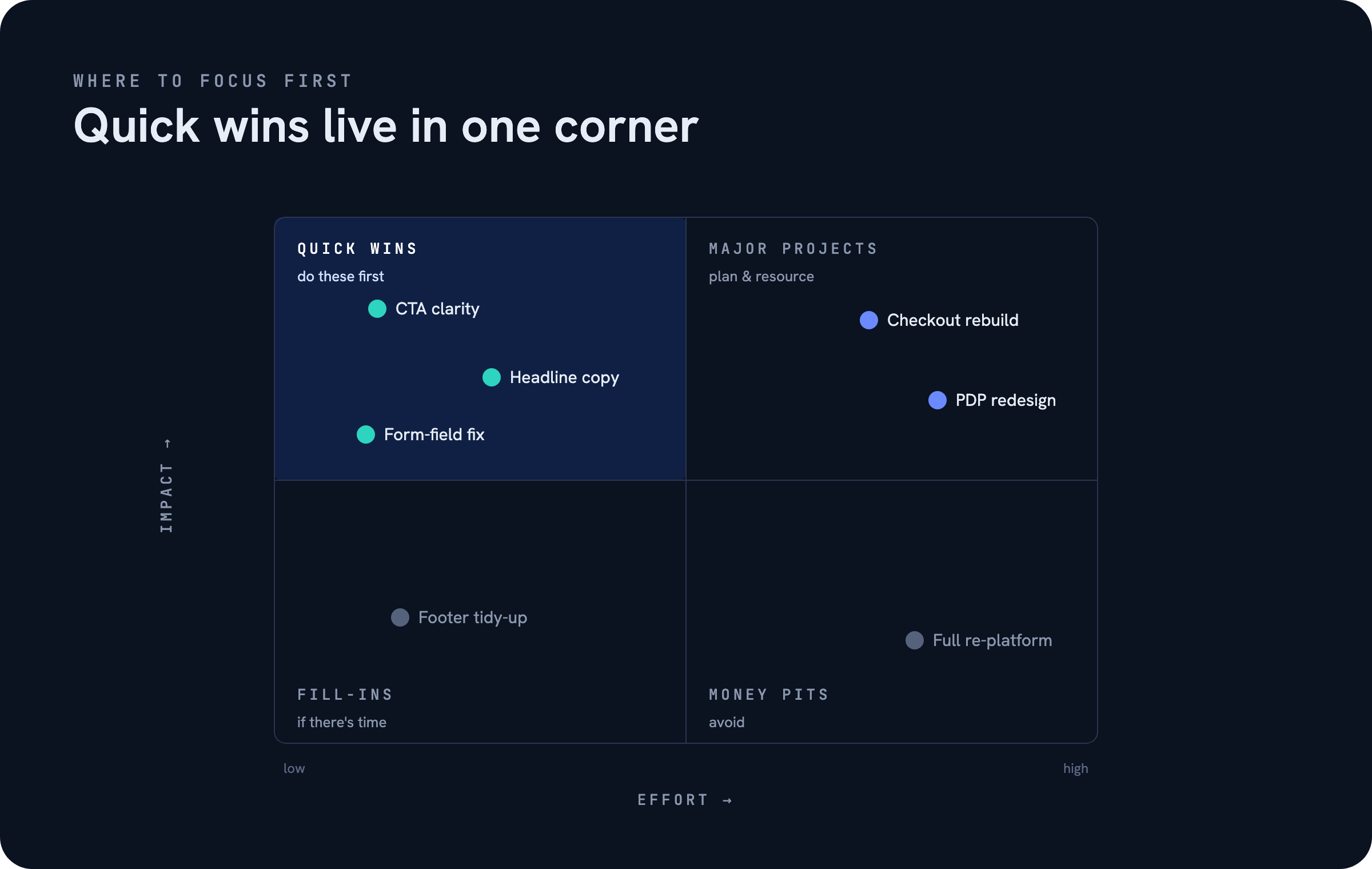
Most websites are leaving conversions on the table in places that take very little effort to fix. The trick isn’t running a massive testing program before you’ve earned it — it’s finding the handful of changes that are cheap to make and likely to pay off quickly. In conversion rate optimization (CRO, the practice of getting more of your existing visitors to take the action you want), these are the “quick wins”: low effort, high impact, fast to ship.
What actually counts as a quick win?
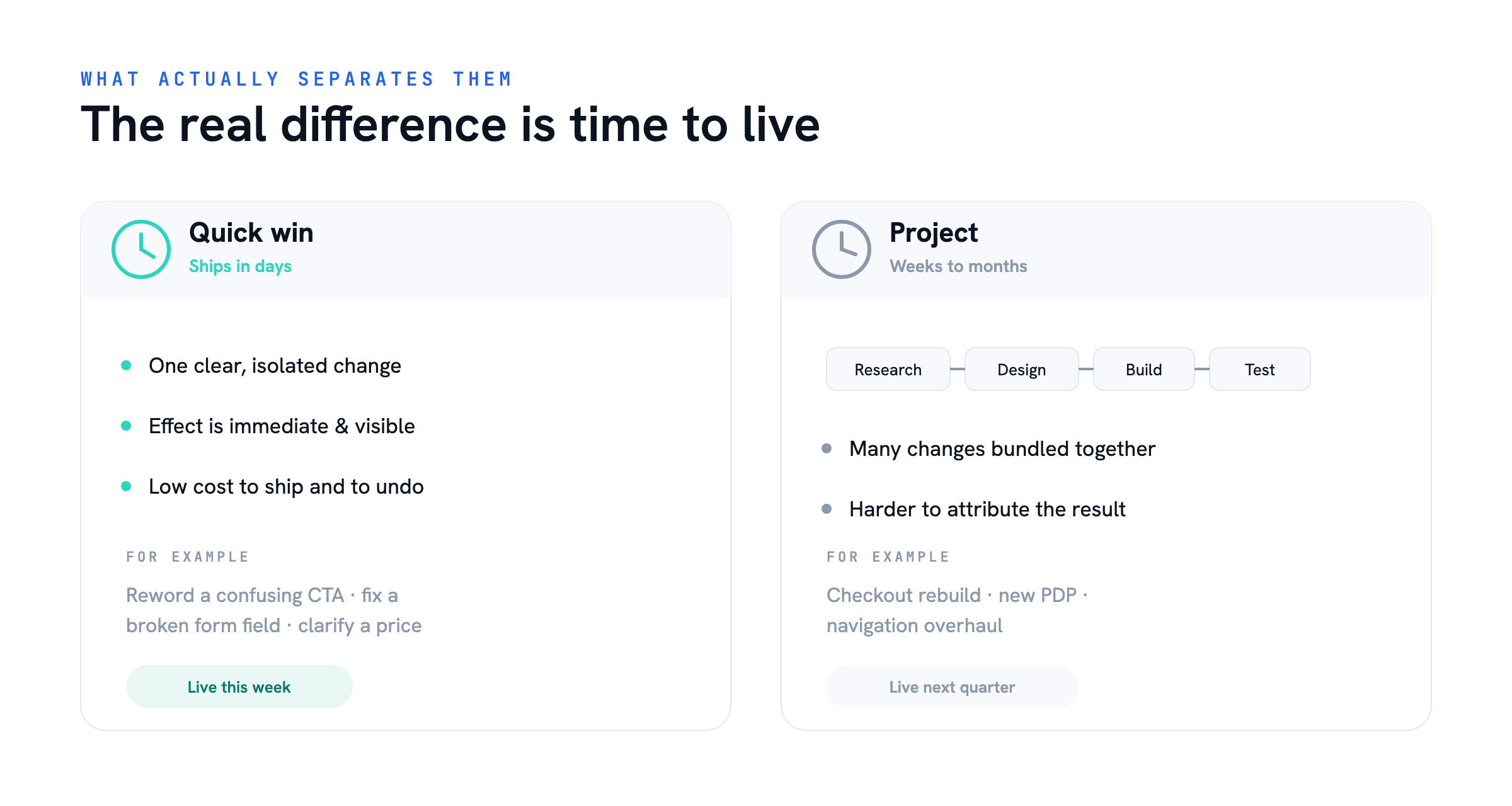
A quick win is a change that takes little effort to implement but has a real chance of lifting conversions right away.
The difference between a quick win and a longer-term project isn’t how clever the idea is — it’s how long it takes to get live on your site. A copy change on a high-traffic landing page, a clearer call to action, fixing a confusing form field: these can ship in days and start working immediately. Redesigning your checkout flow or rebuilding a product page is a different kind of work — it needs research, design, development, and careful testing before it’s safe to launch.
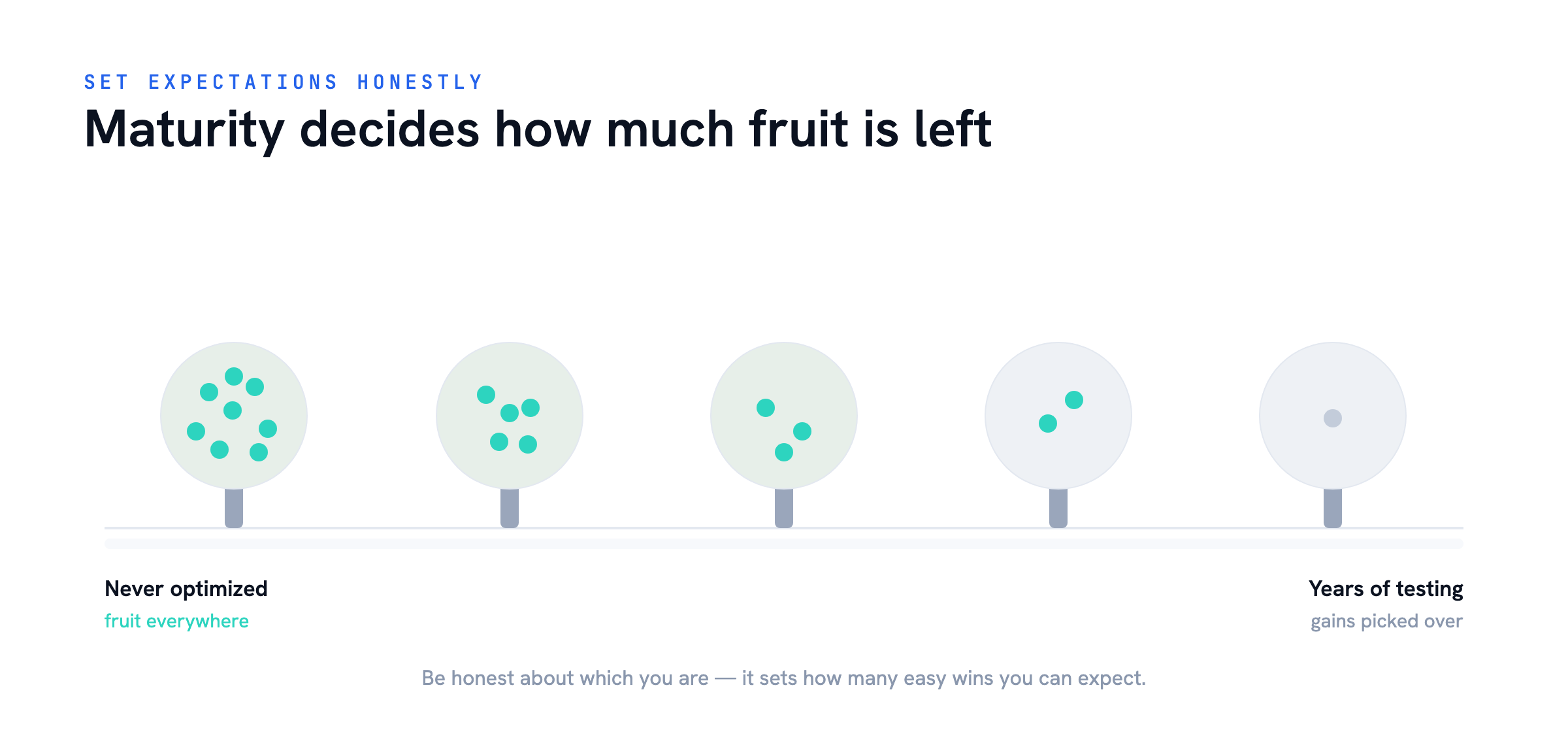
Where you’ll find the most quick wins depends on your maturity. If you’ve never done any structured optimization, there’s usually low-hanging fruit everywhere. If you’re an established business that’s already been testing for years, the easy gains are mostly picked over, and the remaining work is more deliberate. Be honest about which one you are — it tells you how much to expect.
Where do you start looking?
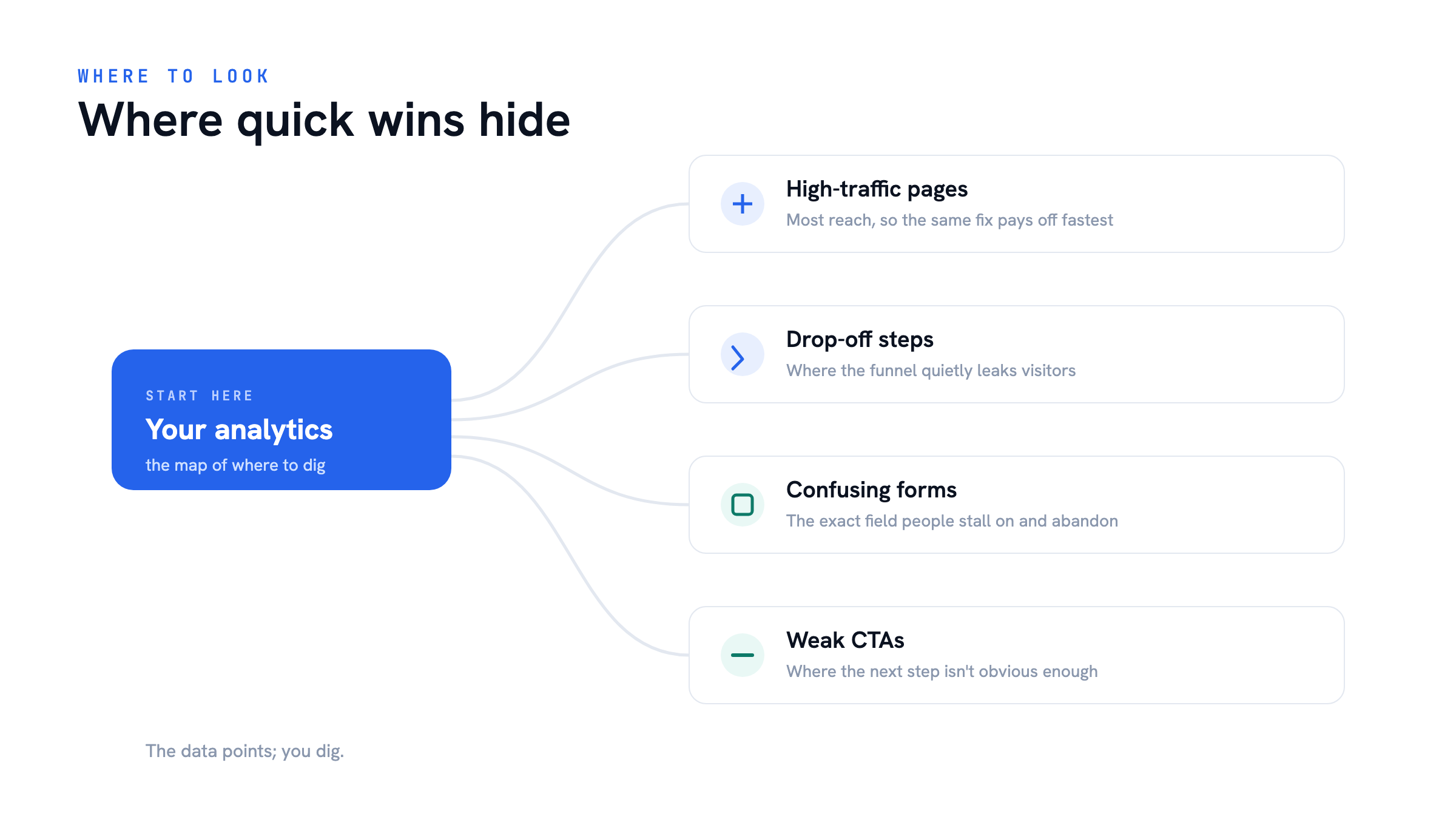
Start in your analytics, but don’t stop there.
Your analytics platform is the right foundation. It tells you which pages get the most traffic, what their conversion rates are, where people bounce, and how long they stay. That’s how you spot the pages worth your attention — a high-traffic page with a weak conversion rate is exactly where a small fix can move real numbers.
But analytics only tells you what is happening, not why. It can show you that visitors leave a page; it can’t tell you they left because the headline was confusing or the form asked for too much. That’s where qualitative tools come in — heat maps, session recordings, on-page polls, and short surveys that show you how real people actually behave. Combine the two: use the numbers to find the page, and use the behavior to understand the problem. That combination is what turns a guess into a hypothesis worth acting on.
How do you prioritize what to fix first?
Work backward from your single most important goal.
Decide what the page or the funnel is ultimately for, then start at the end and move backward. For an online store, the goal is a completed order, so the checkout and confirmation steps are where lost conversions cost you the most. If people are struggling to finish checkout, helping more of them through is one of the highest-value fixes you can make.
Here’s the tension, though: the highest-value area is often the riskiest place to change. Get a checkout edit wrong and you can lose real money. So weigh impact against risk. A genuine quick win sits where the effort is low and the risk is contained — a usability fix or a clearer design on a high-impact page, not a wholesale rebuild of the step that processes payments. Save the hard, high-stakes changes for a proper test once you’ve banked the easy gains.
What makes a quick win actually “quick”?
Three things, together: it’s fast to implement, it carries low risk, and it sits on a page that already matters. Drop any one of those and it’s not a quick win — it’s a project. Find all three in the same place, and you’ve found the work to do first.
Quick wins are the fastest way to prove that optimization pays — but they’re only the start, and spotting the right ones takes a trained eye on your analytics and your user behavior. If you want help finding where your site is leaking conversions and what to fix first, that’s exactly what a conversion review is for. [Book a consultation](/contact/) and we’ll take a look.