Every AI marketing capability needs an explicit answer to one question: can this act alone, or does a person sign off first? Most teams never actually answer it. The line gets drawn by default, by whoever configured the tool, usually by accepting whatever autonomy setting the platform shipped with. That’s not a decision. It’s an accident that happens to look like one, right up until the accident produces a result nobody would have approved if they’d been asked.
This framework assumes a capability already has a place in your workflow: the separate question of which workflow stage AI belongs in at all is covered in where AI actually fits in a marketing workflow, which scores placement on volume, repeatability, and verifiability rather than the reversibility, cost-of-error, and brand-risk factors below. Placement decides where AI operates; this decision-rights framework decides how much it’s trusted to do on its own once it’s there.
Key takeaways
- Most teams never explicitly decide which marketing decisions an AI system may make alone: the line gets drawn implicitly by whoever configured the tool, usually without weighing reversibility, cost of a wrong call, or brand risk as the actual criteria.
- The decision-rights framework scores any AI marketing capability on three factors (reversibility, cost of error, and brand risk) and the combined score, not a vendor’s autonomy default, is what should decide the human-in-the-loop line.
- An autonomous bid adjustment and an autonomous customer-facing message look like the same category of decision from a distance. They score almost oppositely on all three factors, which is exactly why one belongs on autopilot and the other never should.
- The line isn’t fixed once. A capability’s score changes as reversibility, error cost, or brand exposure changes, so the framework is a standing check, not a one-time configuration step.
Why does nobody actually decide this on purpose?
Which AI marketing decisions need human approval, and which can run on AI autonomy alone, is a question almost nobody asks on purpose: because the decision hides inside a configuration screen, not a meeting. A platform ships with a default: this feature runs automatically, that one requires approval. Someone clicks through setup, accepts the defaults, and moves to the next tool. Nobody asks, for this specific capability, what happens if it’s wrong and whether that’s reversible. The vendor answered that question for them, and the vendor’s incentive is adoption, not your brand’s risk tolerance.
This isn’t a story about a careless team. It’s what happens when a real decision (how much authority a system gets) gets absorbed into a setup wizard built to get a tool running fast, not to weigh your brand’s specific risk tolerance. The wizard doesn’t know your brand had a public misstep last year that makes a customer-facing autonomy failure more expensive than its generic risk model assumes. Only your team knows that, and only your team can ask.
What actually belongs in the decision?
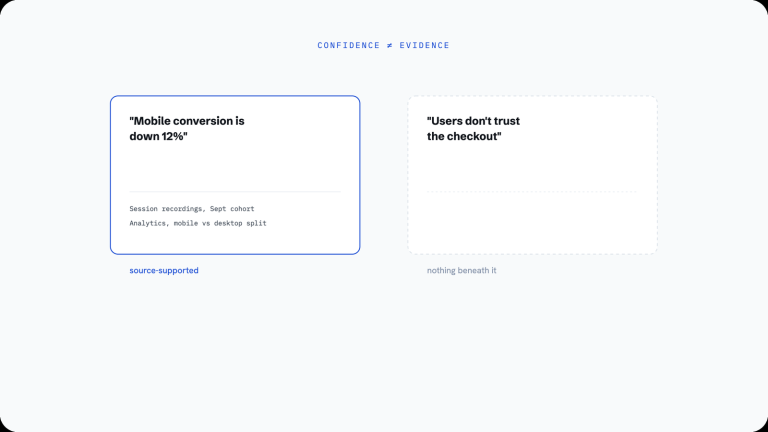
Three factors, not one. Teams that do think about this at all usually reach for a single proxy (“how confident is the model?”) and stop there. Confidence is the wrong axis. A model can be highly confident and still be making a decision your team would never delegate, because confidence measures the model’s certainty about its own output, not what happens to your business if that output is wrong.
The three factors that actually matter:
Reversibility. If the AI’s action turns out wrong, how hard is it to undo? A bid adjustment that overspends for six hours gets corrected by the next budget check. A customer email that goes out with the wrong offer to your full list is in ten thousand inboxes the moment it sends, and no correction reaches the people who already read it.
Cost of error. If it’s wrong, what does that actually cost: in dollars, in a bad customer experience, in staff time spent cleaning it up? A misallocated ad dollar costs an ad dollar. A factually wrong claim in a customer-facing message can cost a customer relationship, or worse, become the screenshot that costs several.
Brand risk. Does a wrong output, if a customer or the public sees it, damage trust in a way that outlasts the specific incident? An internal reporting error nobody outside the team ever sees carries none. A customer-facing message with the wrong tone, an inaccurate promise, or language that reads as tone-deaf carries all of it, and it carries it publicly.
Score a capability low-medium-high on each of the three, and the combined picture (not any one factor alone) is what tells you where the human-in-the-loop line belongs.
Where does a low-scoring capability land, and where does a high-scoring one land?
Low on all three: let it run. A capability that’s cheap to reverse, cheap to get wrong, and invisible to anyone outside the team is exactly the kind of decision that doesn’t need a person checking it every time. Requiring sign-off here doesn’t add safety. It adds a bottleneck with no corresponding reduction in real risk, and it trains the team to rubber-stamp approvals because none of them ever actually matter, which quietly erodes the seriousness of approval everywhere else in the workflow too.
High on any one of the three: keep a human in the loop, full stop. This is the part teams under-weight. A capability doesn’t need to score high on all three factors to require a human check: one high score is enough, because the three don’t average out. A decision that’s perfectly reversible and cheap to fix but carries real brand risk (a public-facing statement, say) still needs a person reviewing it before it goes out, because the damage from a bad customer-facing moment isn’t undone just because the system could technically retract it.
High on two or three: sign-off isn’t optional, and it shouldn’t be a formality. When reversibility is low, error cost is real money or real relationships, and brand exposure is public, the review step needs a genuine check by someone with the authority to catch a bad call, not a rubber-stamp click added to satisfy a policy.
Two worked examples: same category, opposite answer
Both examples below are constructed to demonstrate the scoring model (illustrative), not drawn from a specific, identifiable client engagement. No outcome, dollar figure, or lift is attached to either.
An autonomous bid adjustment
A capability that shifts ad spend across campaigns in response to real-time performance signals, without a person approving each shift.
- Reversibility: high. The next budget cycle, often the next few hours, corrects a bad allocation. Nothing about a wrong bid decision is permanent.
- Cost of error: low to moderate. A misallocation wastes some ad spend for a bounded window. It’s a real cost, but a contained and quantifiable one, and it’s denominated entirely in dollars the team already budgeted to spend somewhere.
- Brand risk: near zero. No customer sees a bid adjustment. It’s an internal allocation decision with no public-facing surface at all.
Low on all three. This is a strong candidate for full autonomy, with a person reviewing aggregate performance on a schedule, not every individual shift. Sign-off on each adjustment would slow the system down without meaningfully reducing risk that’s already small and self-correcting.
An autonomous customer-facing message
A capability that generates and sends a message directly to a customer (a personalized offer, a service update, a win-back email) without a person reviewing it first.
- Reversibility: low. Once it’s sent, it’s sent. There’s no recall on a message a customer has already opened and read.
- Cost of error: potentially high. A wrong offer, an inaccurate claim, or a tone-deaf message to a customer mid-complaint doesn’t just cost the price of the message. It can cost the relationship, and in a bad case, it becomes the thing the customer shares publicly.
- Brand risk: high. This is the definition of a public-facing surface. Every recipient is a potential witness to a mistake, and the message itself is durable evidence of what the brand said, in the customer’s own inbox, indefinitely.
High on reversibility (in the bad direction), high on cost, high on brand risk. This capability requires a person in the review chain, not as a formality: the review step is the only thing standing between a plausible-sounding draft and a message a real customer receives with the brand’s name on it.
The two capabilities look superficially similar (both are “AI decides and acts”) and score almost opposite on every factor that actually matters. Treating them the same, either by requiring sign-off on both or automating both, ignores the only information that should be driving the decision in the first place.
The line isn’t a one-time setting
A capability’s score isn’t fixed forever. A bid-adjustment system that starts managing a modest test budget and later gets handed the entire paid-media budget has changed its cost-of-error score significantly, even though nothing about the underlying mechanism changed. A customer-messaging system that starts on a small pilot list and later gets pointed at the full customer base has changed its brand-risk exposure the same way, by scale alone.
The framework isn’t something a team applies once and forgets. It’s a standing check, re-run whenever a capability’s scope, audience, or budget changes meaningfully: because the autonomy decision that was correct at pilot scale isn’t automatically still correct at full production scale.
The teams that get burned by this aren’t the ones who decided, on purpose, to let an AI system send customer messages unsupervised. Almost nobody makes that call deliberately. They’re the teams who never made a call at all: they accepted a platform’s default autonomy setting the same way they accepted its default font size, because neither felt like a decision worth stopping for. The bid-adjustment engine and the customer-messaging tool got the same five minutes of setup attention, and only one of them deserved it.
What to do next
- List every AI marketing capability currently live on your stack, and for each one, write down its actual autonomy setting today, not what you assume it is, what it’s actually configured to do.
- Score each one on reversibility, cost of error, and brand risk (low/medium/high is enough precision to start). Flag anything scoring high on even one factor that’s currently running without a human sign-off.
- For anything flagged, name the specific person who reviews it before it acts, not a team or a process: an unnamed reviewer is the same gap as no reviewer.
- Re-run this check whenever a capability’s scope changes (a bigger budget, a larger send list, a new customer segment), not just when the tool is first configured.
- If you haven’t yet confirmed a given capability is a genuine AI system and not automation with an AI label on it, run the falsifiable test for that distinction first: the decision-rights question below only matters once you know what kind of system you’re actually scoring.
Where this fits
This is an Experiment and Personalize article that sits at the governance layer underneath both stages: it draws the human sign-off line for a capability already built, not whether to build it in the first place. In practice, this is what “keep a human involved” actually means once it’s more specific than a slogan: not a blanket policy, but a scored answer to which capability, at what score, gets to run without a person reviewing it first.
Written by Alex Harris. The scoring model above is the same question I ask every time a new AI capability enters a stack: what happens if this is wrong, and who’s actually agreed to let it run without a check first. View My Résumé
If your team has AI marketing capabilities running today with nobody able to say, specifically, what their autonomy setting is or why, start with the list above and write down each one’s actual setting before the next one goes live unsupervised.